Hybrid Cable infrastructure represents the ultimate evolutionary step for modern maritime, offshore, and industrial connectivity. As commercial vessels, naval fleets, and remote ocean platforms deploy high-bandwidth sensors, remote-operated vehicles, and automated telemetry systems, supplying reliable power alongside ultra-fast data becomes a paramount engineering challenge. Fibre Systems manufactures specialized composite cabling solutions engineered to survive the most punishing offshore conditions on the planet.
Operating electronic hardware in remote marine environments presents physical constraints that traditional wiring simply cannot handle. Running separate copper power lines and optical fiber data links doubles installation labor, increases total deck weight, and creates multiple vulnerability points for moisture ingress and mechanical damage. When subsea sensors or deck-mounted surveillance systems lose power or signal integrity during critical operations, the resulting financial loss can reach tens of thousands of dollars per hour.
Engineers, naval architects, and offshore project managers need an integrated cabling architecture that guarantees continuous power delivery and uncompromised bandwidth. Understanding how composite insulation, high-tensile strength members, and specialized shielding eliminate interference inside a single jacket is essential for building resilient marine systems. Every meter of wiring deployed across high-seas infrastructure must perform flawlessly under perpetual dynamic motion and high mechanical stress.
What Is a Hybrid Cable Assembly?
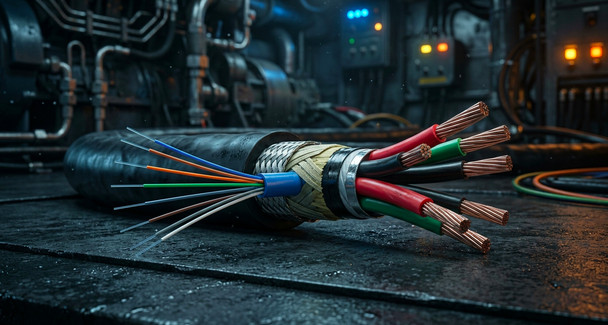
A Hybrid Cable assembly is an advanced composite optical and electrical conductor designed to deliver electrical power and high-speed fiber data transmission within a single, unified outer jacket. By integrating heavy-gauge copper conductors alongside high-precision singlemode or multimode optical fibers, this composite architecture eliminates the need to route independent electrical and telecommunications lines across complex marine structures.
The optical fiber tubes inside the assembly handle gigabit-rate data transmission, video feeds, and sensor control signals without electromagnetic susceptibility. Simultaneously, the insulated copper conductors deliver direct current or alternating current power to remote devices such as underwater cameras, sonar heads, navigation buoys, and deck-mounted communications nodes.
Unlike conventional cables that require double the mounting hardware and separate bulkhead penetrations, a composite assembly streamlines system design. High-spec internal engineering ensures that high-voltage electrical current flowing through adjacent copper wires does not generate thermal or mechanical stress that could disrupt delicate optical fiber elements housed within the same protective sheath.
Deploying a certified Hybrid Cable system ensures that offshore platform managers and marine vessel technicians achieve maximum operational efficiency. Combining essential utilities into one ruggedized outer housing reduces cable weight, minimizes deck clutter, and eliminates the spatial bottlenecks commonly found in crowded marine conduits.
Common Challenges in Remote Marine Power and Data Distribution
Distributing power and high-speed data across marine environments exposes infrastructure to severe mechanical, chemical, and environmental hazards. Traditional dual-cable deployments frequently suffer from structural degradation, leading to unexpected signal dropouts and power loss.
- Severe Structural Weight and Drag: Running separate heavy-gauge copper lines and armored fiber cables adds significant weight to subsea tether lines and vessel cable trays, causing severe drag and mechanical strain during deployment.
- Electromagnetic Interference Risk: Poorly shielded power lines running adjacent to data cables induce electrical noise, causing data corruption, frame drops, and latency issues in sensitive control systems.
- Corrosive Saltwater and Chemical Exposure: Constant exposure to saltwater spray, diesel fuel, hydraulic fluids, and ozone degrades standard PVC cable jackets, leading to jacket cracking and internal conductor corrosion.
- Extreme Mechanical Shock and Dynamic Bending: Subsea tethers and deck-mounted cables endure perpetual flexing, twisting, and ocean wave impact, causing internal wire fatigue, micro-bending loss, and conductor snapping.
- Multiple Bulkhead Penetration Failures: Routing separate power and data cables through shipboard bulkheads creates twice as many sealing points, drastically increasing the risk of water ingress during heavy weather.
Specifying a ruggedized Hybrid Cable eliminates these operational failure points effectively. By combining power and fiber inside an armored, water-blocked jacket, offshore operators streamline cable routing while dramatically increasing hardware survivability in harsh ocean environments.
Technical Performance Standards for Composite Hybrid Cable Assemblies
Evaluating the structural and electrical parameters of a Hybrid Cable assembly ensures proper integration into mission-critical marine and industrial systems.
- Optical Fiber Capabilities: Houses OS1, OS2 singlemode, or OM3, OM4 multimode fibers in crush-resistant gel-filled loose tubes for maximum signal protection.
- Copper Conductor Specs: Features high-purity stranded tinned copper conductors ranging from 12 AWG to 20 AWG to supply low-loss AC or DC power.
- Dielectric Voltage Resistance: High-grade insulation materials support operating voltages up to 600V or higher depending on marine equipment power requirements.
- Water-Blocking Construction: Internal swellable tape and water-blocking compounds prevent axial moisture migration along the cable core if the outer jacket becomes punctured.
- High-Tensile Strength Member: Integrated Kevlar aramid yarn or stainless steel central strength members support high tensile pulling loads exceeding 2,000 Newtons.
- Outer Sheath Durability: Polyurethane or LSZH flame-retardant jacketing provides exceptional resistance to abrasion, UV radiation, ozone, and marine chemicals.
- Broad Operating Temperature Range: Standardized to operate reliably between negative forty degrees Celsius and positive eighty-five degrees Celsius under full electrical load.
Comparison: Traditional Dual-Cable vs. Integrated Hybrid Cable Architecture
Selecting the correct cabling approach directly impacts deployment cost, vessel weight, and system reliability over time. The clean comparative table below details why composite architecture outperforms traditional dual-cable installations and pastes perfectly into Microsoft Word or engineering documentation.
| Evaluation Criteria | Traditional Dual-Cable Setup | Fibre Systems Hybrid Cable |
| System Footprint & Weight | Heavy, double cable diameter | Lightweight, single jacket profile |
| Installation Labor Cost | High (Requires dual pulls & trays) | Reduced by up to 50 percent |
| Bulkhead Penetrations | Requires two separate penetrations | Requires single sealed penetration |
| Electromagnetic Shielding | Variable (Prone to cross-talk) | Individual shield foil plus braid |
| Crush and Tensile Strength | Moderate (Standard jacket limits) | Superior (Aramid reinforced core) |
| Subsea Tether Drag | High drag coefficient in current | Streamlined hydro-dynamic profile |
| Operational Lifespan | 2 to 4 years in harsh conditions | Extended (10+ years continuous) |
Traditional installations require separate runs for electrical supply and optical signal transmission, double material cost and installation time. Utilizing an integrated Hybrid Cable streamlines logistical management on site, allowing engineering teams to pull power and fiber simultaneously through tight vessel conduits.
Furthermore, composite cabling minimizes cable management complexity on winches and deck cranes. A single continuous composite line winds evenly onto storage reels without the tangling, uneven tensioning, and abrasion that naturally occur when managing two separate cable lines side by side.
Eliminating Cross-Talk and Thermal Stress in Composite Cabling
A primary concern when designing composite power and optical cables is preventing electrical noise and heat from affecting sensitive glass fibers. An advanced Hybrid Cable addresses this challenge through meticulous internal geometry and heavy-duty shielding materials.
Each copper power conductor inside the cable is individually wrapped in aluminum-mylar foil shielding and covered with a fine tinned copper braid. This double-layer shielding traps electromagnetic emissions generated by high-current surges, preventing inductive coupling into adjacent optical fiber tubes.
To counteract thermal stress, specialized heat-resistant insulation compounds separate copper conductors from optical fibers. Even when electrical lines operate at elevated temperatures during maximum power delivery, the low thermal expansion profile of the internal buffer tubes protects glass fibers from micro-bending loss.
Choosing a composite Hybrid Cable engineered with high-density Kevlar strength members ensures that mechanical loads are distributed uniformly across the core structure. During heavy sea pulls, tensile stress transfers directly to the aramid fibers, keeping delicate optical strands completely free from strain and signal attenuation.
Compliance with Australian and International Marine Wiring Standards
Offshore and marine electrical installations must adhere strictly to international maritime regulations, safety standards, and Australian cabling guidelines to ensure operational clearance.
Compliance with the Australian Communications and Media Authority guidelines guarantees that combined telecommunications and electrical distribution hardware satisfies rigid electromagnetic compatibility and safety regulations. When deploying composite cables, technicians must follow regulatory wiring standards to prevent electrical interference, fire hazards, and structural deck damage.
Key cabling standards applicable to vessel composite installations include:
- AS/CA S008: Mandatory requirements for customer cabling products, specifying flame retardancy, toxic smoke emission limits, and jacket material durability.
- IEC 60092-350: Electrical installations in ships, governing general construction and testing requirements for power, control, and telecommunications cabling.
- IEC 60332-3-22: Tests on electric and optical fiber cables under fire conditions, certifying bundle flame resistance in vertical cable trays.
- DNV / ABS Marine Class Certifications: International marine classification standards verifying high tensile strength, water-tightness, and oil resistance for offshore deployments.
Deploying non-compliant composite wiring inside shipboard machinery spaces introduces severe safety risks during regulatory audits. Every Hybrid Cable manufactured for industrial marine use undergoes stringent factory testing to certify that flame-retardant, low-smoke zero-halogen jackets satisfy international safety codes.
Adhering to AS/CA S008 guidelines ensures that composite wiring deployed across Australian commercial ports and offshore oil rigs maintains structural stability and zero halogen emissions during high-temperature electrical faults.
Step-by-Step Installation Guide for Composite Cables in Marine Environments
Executing proper installation techniques preserves internal fiber geometry, prevents conductor damage, and ensures long-term moisture resistance.
Step 1: Calculate Pulling Tension and Minimum Bend Radius
Review the manufacturer specification sheet to verify maximum allowable pulling tension and minimum bend radius limits. Ensure cable sheaves, pulleys, and winch drums feature smooth grooves sized appropriately for the composite cable diameter.
Step 2: Prepare Bulkhead Transit Seals
Install rated modular marine frame transit seals at bulkhead passage points. Verify that the inner elastomer insert matches the exact outer diameter of the Hybrid Cable to guarantee a watertight and gas-tight seal upon compression.
Step 3: Pull Cable Using High-Tensile Swivels
Attach a specialized pulling grip over the aramid strength member of the cable. Always use a mechanical swivel between the pulling rope and the cable eye to prevent internal twisting during long conduit pulls.
Step 4: Separate Power and Fiber Cores at Junction Enclosures
Carefully strip the outer polyurethane jacket using a specialized ring tool, taking care not to nick internal buffer tubes or wire insulation. Route copper conductors to power distribution blocks and optical fibers to splash-proof patch trays.
Step 5: Perform Grounding and Optical Testing
Connect the overall copper braid shield to the primary vessel earth ground point to ensure complete electromagnetic drain. Test every optical fiber strand using an Optical Time-Domain Reflectometer to establish baseline loss records.
Field Maintenance and Inspection Protocols for Offshore Composite Cables
Establishing routine inspection procedures prevents minor outer sheath wear from turning into catastrophic electrical shorts or total fiber loss.
- Visual Sheath Inspection: Inspect accessible cable runs monthly for outer jacket abrasion, deep cuts, chemical swelling, or sharp bends caused by shifted deck equipment.
- Continuous Insulation Resistance Monitoring: Measure insulation resistance between copper conductors and overall shield using a high-voltage megohmmeter to detect moisture ingress before shorts occur.
- Optical Loss OTDR Testing: Conduct semi-annual Optical Time-Domain Reflectometer traces to identify localized micro-bends, connector degradation, or stress points along the Hybrid Cable run.
- Bulkhead Seal Compression Checks: Inspect modular bulkhead transit frames quarterly to ensure compression bolts remain tight and elastomer blocks show no signs of weather cracking.
Outer jacket damage represents the most common entry point for moisture in marine environments. If seawater penetrates an unsealed outer sheath, high ocean pressure forces water axially along internal wire strands, corroding copper conductors and causing micro-bending losses in optical fibers.
Using a Hybrid Cable constructed with internal water-blocking gels and swellable aramid tapes prevents water migration along the cable interior. If an outer jacket puncture occurs during heavy weather, internal swellable materials expand instantly upon contact with moisture, sealing the leak locally and protecting the remaining cable run.
Deploying Composite Cabling in Unmanned Underwater Vehicles and Sonar Systems
Unmanned Underwater Vehicles, Remotely Operated Vehicles, and towed sonar arrays rely on composite umbilical tethers to transmit high-definition video feeds while receiving high-voltage operational power.
A specialized Hybrid Cable serves as the core lifeway between the surface support vessel and deep-water subsea packages. The cable must deliver hundreds of volts of electrical power to operate hydraulic thrusters and high-intensity LED lights while transmitting multi-gigabit camera data to surface operators in real time.
Because subsea tethers operate under perpetual ocean current drag and extreme hydrostatic pressure, cable weight and diameter must be kept to an absolute minimum. Composite cabling engineered with high-strength synthetic aramid fibers achieves an ideal strength-to-weight ratio, allowing oceanographic research teams to deploy equipment to extreme depths.
Furthermore, the integration of custom buoyancy-neutral jackets allows a Hybrid Cable umbilical to float or sink as required by specific mission parameters. Neutral buoyancy prevents subsea tethers from tangling around seabed structures or getting caught inside thruster blades during delicate recovery maneuvers.
Enhancing Reliability in Remote Mining and Heavy Industrial Operations
While maritime applications demand exceptional fluid resistance, land-based remote mining operations present equal challenges in terms of mechanical impact, dust, and continuous vibration.
Deploying a Hybrid Cable across open-cut mine sites or underground haulage shafts provides a centralized solution for powering autonomous haul trucks, remote drill rigs, and site-wide wireless mesh access points. Rather than running separate power lines and fragile communications cabling across dusty, rock-strewn terrain, heavy equipment operators deploy a single armored composite cable.
In open-cut mining environments, heavy mobile machinery frequently runs over surface cabling. Composite cables featuring corrugated steel tape armor or thick polyurethane outer sheaths absorb severe mechanical crush loads without crushing internal optical fiber tubes or shorting high-current copper wires.
Additionally, using an integrated Hybrid Cable setup simplifies emergency field repairs. Technicians only need to stock a single cable assembly type in service vehicles, reducing downtime and lowering spare parts inventory management costs across remote operational sites.
Future-Proofing Industrial Facilities with Unified Composite Networks
As smart factories, offshore wind farms, and automated ports transition toward Industry 4.0 standards, demand for distributed power and ultra-fast data connectivity continues to accelerate exponentially.
Installing a high-density Hybrid Cable framework throughout the new industrial facility builds future-proof infrastructure against evolving bandwidth and power requirements. As edge devices, automated guided vehicles, and smart sensors proliferate, having combined power and optical pathways already installed eliminates the cost of retrofitting new conduit lines.
Furthermore, integrating composite cables into utility distribution networks simplifies the deployment of Power over Ethernet extensions and remote antenna systems. Delivering high-voltage DC power across copper cores allows optical conversion nodes to operate hundreds of meters away from primary power distribution panels without requiring local utility hookups.
Partnering with technical specialists ensures that your selected Hybrid Cable configuration features the exact conductor gauge, fiber count, and outer jacketing required to meet present operational demands while accommodating future technology upgrades seamlessly.
Frequently Asked Questions
Can high-voltage power lines inside a composite cable cause interference in fiber optic signals?
No. Fiber optic cables transmit data using light pulses through glass cores, making them completely immune to electromagnetic interference generated by adjacent copper power lines. However, heavy-duty foil and braid shielding are included around the copper wires to prevent interference with other nearby electrical components.
What happens if seawater penetrates the outer jacket of a composite cable?
Marine-grade composite cables utilize internal water-blocking tapes and swellable aramid yarns. If the outer jacket is damaged, these specialized materials expand upon contact with water, creating a localized pressure seal that prevents moisture from traveling along the interior of the cable.
Is a Hybrid Cable suitable for dynamic flexing applications like cable tracks or winches?
Yes, provided you select a cable specifically rated for high-flex service. Dynamic composite cables feature finely stranded copper conductors, extra-flexible fiber buffer tubes, and tough polyurethane outer sheaths designed to endure millions of continuous flex cycles.
What is the maximum distance power can be delivered over composite cabling?
Power delivery distance depends on voltage level, current draw, and copper wire gauge. By increasing voltage at the power source and utilizing step-down converters at the remote end, power can be transmitted several kilometers along heavy-gauge copper conductors alongside long-distance singlemode fiber runs.
How are composite cables terminated at junction boxes?
Composite cables are terminated inside specialized breakout enclosures where the outer jacket is stripped back. Copper power wires are routed to heavy-duty terminal blocks or power connectors, while optical fiber strands are spliced into patch panels using standard optical connectors such as SC, LC, or ST types.
Strategic Summary
- Hybrid Cable assemblies combine heavy-gauge electrical conductors and ultra-fast optical fibers into a single, highly durable outer jacket.
- Combining power and fiber streamlines installation, reduces overall vessel weight, minimizes bulkhead penetrations, and lowers drag in subsea applications.
- Advanced foil shielding and specialized buffer tubes eliminate electromagnetic interference and manage internal thermal stress efficiently.
- Full compliance with ACMA guidelines and international maritime IEC standards guarantees vessel safety, fire retardancy, and operational approval.
- Implementing strict pulling tension controls, proper strain relief, and continuous insulation testing prevents unexpected hardware downtime in remote marine environments.
Secure Your Marine Fiber Network Today
Marine fiber optic and power networks demand absolute structural reliability. Selecting sub-standard cabling hardware introduces catastrophic points of failure that threaten subsea operations, vessel propulsion controls, and remote sensor networks. Deploying high-precision Hybrid Cable assemblies guarantees that critical power and data links maintain uncompromised bandwidth and continuous electricity even in severe maritime environments.
Fibre Systems supplies defence-grade, highly reliable optical and composite connectivity solutions tailored specifically to the Australian maritime, mining, and industrial sectors. Protect your remote infrastructure from unexpected downtime by partnering with proven fiber optic specialists.
Contact our technical engineering team today to discuss your custom cable design specifications, or explore our full product range to find ruggedized optical hardware engineered for extreme environment deployment.