Adapter SC Duplex Singlemode interconnects establish critical high-speed optical links across modern commercial and defence vessels. As maritime operations transition toward data-heavy sensor monitoring, automated propulsion controls, and real-time navigation systems, physical infrastructure failure is simply not an option. Fibre Systems manufactures precision-engineered optical interface components designed to withstand the harsh realities of sea deployment.
Maritime communications networks face environmental hazards that static onshore data centres never encounter. Continuous hull vibration, aggressive saltwater corrosion, thermal fluctuations, and mechanical shock constantly strain fiber interconnects. Selecting low-grade interface hardware introduces severe operational risks, including sudden signal dropouts, excessive insertion loss, and permanent alignment failure.
Engineers and marine technicians require hardware that delivers uninterrupted data transmission under severe operational stress. Understanding how physical alignment sleeves, durable housing materials, and precise insertion loss tolerances impact long-term network stability is essential for naval architecture planning. Every single connection point inside a shipboard distribution frame must perform flawlessly despite perpetual rolling, pitching, and machinery vibration.
What Is an Adapter SC Duplex Singlemode Component?
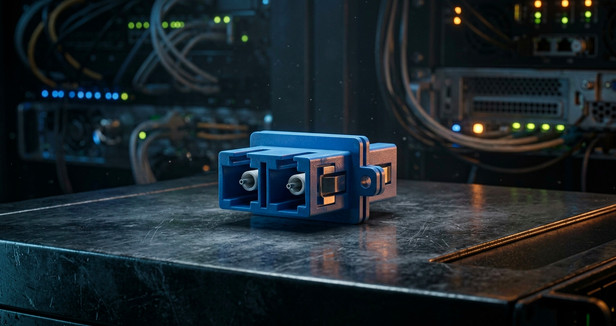
An Adapter SC Duplex Singlemode component is a specialized optical interconnect designed to join two duplex SC singlemode fiber optic patch cables with extreme axial precision. The acronym SC stands for Subscriber Connector, which utilizes a push-pull latching mechanism for quick and secure mating. The term duplex refers to two parallel channels housed within a single module, enabling simultaneous bi-directional data transmission across separate transmit and receive lines.
Singlemode optical fibers feature a tiny core diameter, typically measuring nine micrometers. Because light travels through such a narrow pathway, aligning two singlemode fibers requires sub-micron mechanical tolerances. The adapter relies on a high-precision internal ceramic sleeve, usually made from zirconium dioxide, to hold opposing fiber ferrules in exact physical alignment.
Unlike multimode systems that tolerate slight axial offsets due to their larger core size, singlemode connections experience severe insertion loss if ferrule alignment shifts even slightly. High-quality SC duplex adapters ensure that optical cores align perfectly end-to-end, minimizing reflection and preserving signal integrity across vast vessel communication backbones.
Having a trustworthy Adapter SC Duplex Singlemode installed inside your distribution hubs guarantees that light pulses navigate physical junctions without attenuation. When signal budgets on long vessel runs are tight, every fraction of a decibel saved at the coupler preserves overall system headroom.
Common Causes of Fiber Optic Failure in Maritime Systems
Network failures on ocean vessels rarely stem from broken glass inside main trunk cables. Instead, physical connection points like patch panels and bulkhead couplers represent the primary vulnerability points in marine optical networks. Identifying these root failure mechanisms allows engineers to select hardware built specifically to endure harsh marine environments.
- Constant Vessel Vibration: Engine operation, propeller cavitation, and heavy seas create continuous mechanical vibration. Low-cost plastic adapters gradually loosen, causing ferrule micro-movements that degrade optical signals and increase bit error rates.
- Salt Fog and Humidity Ingress: Salt-laden sea air rapidly corrodes metal spring clips and sub-standard plastic housings, causing structural warping and misalignment inside patch panels.
- Thermal Expansion Stress: Vessels experience broad temperature swings between climate-controlled equipment rooms and unconditioned engine compartments or deckheads. Mismatched thermal expansion coefficients between adapter housings and ceramic sleeves create axial distortion.
- Dust and Fine Particulate Contamination: Engine exhaust soot, deck debris, and particulate matter drift into unprotected ports during routine maintenance, abrading polished ferrule end-faces upon insertion.
- Accidental Cable Strain: Technicians moving equipment inside cramped electronics compartments often apply lateral tension to patch leads, snapping fragile retention latches on low-grade adapters.
Integrating a rugged Adapter SC Duplex Singlemode unit mitigates these failure risks effectively. By deploying couplers specifically rated for maritime shock and thermal variation, fleet operators avoid unexpected signal degradation during critical offshore operations.
Technical Performance Standards for Adapter SC Duplex Singlemode Modules
Understanding the technical construction of an Adapter SC Duplex Singlemode module helps system architects select appropriate hardware for mission-critical marine control networks.
- OS1 and OS2 Singlemode Compatibility: Fully optimized for standard 9/125 micrometer singlemode fibers operating at 1310 nm and 1550 nm wavelengths.
- Zirconia Ceramic Alignment Sleeves: High-density ZrO2 ceramic split sleeves provide sub-micron ferrule alignment, ensuring consistent insertion loss below 0.10 dB.
- Low Insertion Loss Profile: Typical insertion loss ratings remain below 0.10 dB, with maximum allowable limits strictly capped at 0.20 dB across all mating cycles.
- High Return Loss Characteristics: Supports return loss performance greater than 55 dB for UPC polishes and greater than 65 dB for APC polishes, preventing damaging laser back-reflection.
- Broad Operating Temperature Range: Standardized to operate reliably between negative forty degrees Celsius and positive eighty-five degrees Celsius without physical deformation.
- Extended Mating Durability: Designed to endure over one thousand continuous mating cycles with less than 0.1 dB change in overall optical performance.
- Flame Retardant Housing: Manufactured using UL94 V-0 rated high-impact thermoplastic materials to prevent flame propagation in engine rooms.
Comparison: Commercial Grade vs. Marine Grade SC Duplex Adapters
Selecting hardware based purely on initial cost leads to severe operational drawbacks when deployed on sea vessels. The clean comparative table below outlines why marine-grade construction is essential for high-reliability maritime applications and pastes perfectly into Microsoft Word or engineering documentation.
| Evaluation Criteria | Standard Commercial Grade | Fibre Systems Marine Grade |
| Sleeve Material | Phosphor Bronze or Low-Grade Metal | Zirconia Ceramic (ZrO2) |
| Mechanical Retention | Standard Plastic Clip | Reinforced Retaining Latches |
| Alignment Precision | Sub-optimal (1.5 – 2.5 μm) | Sub-micron (≤ 0.5 μm) |
| Resistance to Vibration | Prone to physical displacement | Vibration dampening design |
| Flame and Smoke Standard | Generic ABS Plastic | UL94 V-0 Certified Polymer |
| Operational Lifespan | Short (1 to 2 years at sea) | Extended (10+ years continuous) |
Commercial-grade adapters relying on phosphor bronze alignment sleeves suffer from permanent material deformation over time when subjected to constant vibration. Zirconia ceramic sleeves feature superior elastic memory and hardness, ensuring consistent spring force against fiber ferrules even after hundreds of mating cycles in high-vibration engine rooms.
Specifying a marine-grade Adapter SC Duplex Singlemode ensures that long-term physical retention remains intact. Over years of active service, high-grade zirconia sleeves maintain their exact clamping force, preventing optical power loss during high-seas navigation.
Critical Role of Precision Zirconia Sleeves in Singlemode Transmission
Light propagation through singlemode fiber depends on precise core-to-core physical contact. An Adapter SC Duplex Singlemode component relies on its split alignment sleeve to grip two 2.5 mm ceramic ferrules simultaneously. If the sleeve inner diameter deviates by even one micrometer, light escapes from the core, causing immediate insertion loss spikes.
Zirconia ceramic sleeves deliver ultra-smooth inner surface finishes, allowing optical ferrules to slide into place without scratching delicate glass end-faces. Furthermore, zirconia exhibits exceptional thermal stability matching the expansion profile of ceramic ferrules. This prevents micro-gaps from forming during sudden temperature fluctuations when vessels transit between cold ocean currents and hot tropical climates.
Choosing an Adapter SC Duplex Singlemode built with precision zirconia sleeves maintains return loss performance above 55 dB for UPC polishes and 65 dB for APC polishes. High return loss prevents back-reflections from damaging sensitive laser diodes in optical transceivers, safeguarding expensive head-end communication electronics onboard.
Furthermore, precision sleeves eliminate axial tilt between opposing ferrules. When optical signals travel across an Adapter SC Duplex Singlemode connection, physical core alignment ensures that chromatic and polarization mode dispersion remain well within operational tolerances for high-speed Ethernet communications.
Compliance with Australian and International Wiring Regulations
Maritime optical installations must comply with strict national electrical standards, safety codes, and marine class society rules. Installing compliant hardware ensures vessel safety, smooth class surveys, and long-term network operational approval.
Compliance with the Australian Communications and Media Authority guidelines ensures that telecommunications hardware meets stringent safety and electromagnetic compatibility standards. Within maritime telecommunications setups, installers must follow structured cabling rules to prevent fire hazards, signal degradation, and improper grounding across metal bulkheads.
Key cabling standards applicable to vessel installations include:
- AS/CA S008: Requirements for customer cabling products, specifying flame retardancy, toxic smoke emission limits, and material durability for telecommunications hardware.
- AS/NZS ISO/IEC 14763.2: Implementation and operation of customer premises cabling, defining testing procedures and optical loss limits for singlemode fiber links.
- DNV / ABS Marine Class Rules: Standards governing flame retardant materials, toxic gas emissions during fires, and mechanical vibration limits for shipboard equipment.
- IEC 61754-4: The international standard defining structural dimensions and interface tolerances for all SC type fiber optic connectors and adapters.
Using non-compliant, unrated plastic adapters inside shipboard enclosures risks severe safety violations during regulatory inspections. Every Adapter SC Duplex Singlemode unit sourced from accredited manufacturers undergoes rigorous environmental testing to ensure compliance with flame and smoke emission guidelines.
Ensuring your selected Adapter SC Duplex Singlemode meets AS/CA S008 standards guarantees that the physical enclosure will not emit dangerous halogen gases during high-temperature electrical faults inside sealed marine compartments.
Step-by-Step Installation Guide for SC Duplex Adapters in Marine Enclosures
Proper installation techniques prevent contamination, preserve alignment precision, and protect delicate optical fibers during panel assembly.
Step 1: Inspect and Clean the Panel Cutout
Verify that the patch panel or bulkhead cutout matches the standard SC duplex footprint. Clean away all metal burrs, dust, and paint overspray from mounting surfaces using a lint-free isopropyl alcohol wipe.
Step 2: Mount the Adapter SC Duplex Singlemode Housing
Ensure protective dust caps remain installed on both adapter ports during mounting. Insert the Adapter SC Duplex Singlemode into the panel cutout until side retaining clips click securely into place, or secure using stainless steel mounting screws.
Step 3: Inspect Optical End-Faces Before Connection
Remove protective caps from one side of the Adapter SC Duplex Singlemode. Clean connector ferrules using a dedicated 2.5 mm click-cleaner or lint-free optical swab dipped in high-purity isopropyl alcohol. Inspect the fiber tip with a fiber inspection microscope to verify zero contamination.
Step 4: Mate SC Duplex Connectors with Tactile Verification
Align the keyway latch of the SC duplex connector with the guide slot on the Adapter SC Duplex Singlemode housing. Push the connector gently into the adapter until a distinct mechanical click is felt and heard. Never force connectors into ports.
Step 5: Secure Cable Strain Relief
Secure incoming fiber patch leads to panel management arms using hook-and-loop straps. Ensure cable bend radius remains above minimum specification, typically thirty millimeters, to prevent micro-bending signal loss.
Field Maintenance Strategies for High-Reliability Marine Networks
Routine maintenance prevents unexpected fiber link failures before they impact ship operations. Establishing systematic inspection protocols guarantees maximum network uptime across the vessel life cycle.
- Optical Inspection and Cleaning: Inspect ferrule end-faces with a digital inspection scope before every mating cycle. Clean dry particulates first, followed by wet cleaning with pure isopropyl alcohol if residue persists.
- Visual Fault Location Checks: Perform monthly checks using a red light Visual Fault Locator attached to the Adapter SC Duplex Singlemode interface to identify micro-bends or fractured glass inside patch panels.
- Optical Loss Testing: Measure end-to-end signal attenuation annually using an Optical Loss Test Set. Compare recorded attenuation values against baseline commissioning records to detect gradual degradation.
- Dust Cap Protection: Always install clean rubber protective covers immediately whenever a cable is disconnected from an Adapter SC Duplex Singlemode port to prevent airborne dust accumulation.
Dust contamination remains the leading cause of permanent fiber optic adapter damage at sea. Unprotected adapter ports accumulate fine airborne salt particles. When a technician inserts a patch lead without cleaning, salt crystals smash against ceramic ferrules under high spring tension, permanently pitting glass end-faces and fracturing alignment sleeves.
Maintaining a clean Adapter SC Duplex Singlemode port environment extends hardware operational lifespan dramatically. Implementing simple cleaning procedures saves ship operators tens of thousands of dollars in emergency offshore repair costs.
Addressing High-Density Patching Challenges in Shipboard Enclosures
Space constraints on modern naval and commercial vessels force network designers to maximize port density inside compact enclosures. Fitting dozens of optical channels into small wall-mount boxes requires adapters that maintain structural integrity when crowded together.
An Adapter SC Duplex Singlemode module provides two optical channels within a compact housing footprint. This allows technicians to double signal capacity compared to traditional simplex connectors without requiring additional panel cutouts.
However, high-density patching increases the risk of cable snagging during maintenance. If a technician pulls on an adjacent jumper, lateral strain transfers directly to the Adapter SC Duplex Singlemode housing. Marine-grade adapters feature reinforced housing walls and heavy-duty retaining latches that withstand accidental side pull without cracking or dislodging from the panel frame.
Moreover, utilizing an Adapter SC Duplex Singlemode with clear color-coded housing options simplifies channel identification inside dim machinery spaces. Standard blue housings identify UPC singlemode links, while green housings denote APC singlemode links, preventing costly cross-mating mistakes during high-stress troubleshooting operations.
Longevity and Environmental Resistance in Offshore Applications
Offshore vessels, oil platforms, and naval frigates operate in environments filled with corrosive airborne contaminants, fuel vapors, and hydraulic oils. Standard industrial plastic enclosures degrade rapidly when exposed to these chemicals over extended periods.
Deploying a marine-grade Adapter SC Duplex Singlemode ensures long-term chemical compatibility. Advanced engineering polymers used in premium adapter construction resist softening or cracking when exposed to grease, oil mist, or cleaning solvents used on board.
In addition, severe temperature cycling between sub-zero Arctic waters and tropical engine rooms causes low-quality plastics to become brittle. A high-spec Adapter SC Duplex Singlemode utilizes thermally stable polymers that retain mechanical flexibility and structural strength across extreme thermal cycles.
By investing in ruggedized Adapter SC Duplex Singlemode components during initial vessel construction, marine engineers ensure that physical layer connectivity remains operational for the entire design life of the vessel.
Strategic Network Integration for Modern Vessel Automation
Modern marine architectures integrate navigation, engine diagnostics, crew communications, and tactical defence systems onto unified fiber optic networks. This convergence requires total physical link reliability across every ship compartment.
Placing a high-reliability Adapter SC Duplex Singlemode at every bulkhead pass-through and distribution hub guarantees consistent optical performance. Whether transmitting radar data to the bridge or monitoring engine temperature sensors, low insertion loss couplers protect bandwidth integrity.
As vessel systems migrate toward higher speed protocols such as 10G, 40G, and 100G Ethernet, optical loss margins become increasingly tight. A single loose or misaligned Adapter SC Duplex Singlemode coupler can push total link loss past allowable limits, triggering packet drops and network latency.
Upgrading legacy patch infrastructure to premium Adapter SC Duplex Singlemode modules provides immediate performance improvements. Reduced attenuation allows optical transceivers to run cooler and last longer, enhancing overall system reliability across the entire vessel fleet.
Frequently Asked Questions
What is the primary difference between APC and UPC SC duplex adapters?
SC adapters themselves use identical outer housings, but internal sleeve tolerances differ based on ferrule polish types. Angled Physical Contact adapters feature green housings designed for eight degree angled ferrules, whereas Ultra Physical Contact adapters use blue housings for flat polished ferrules. Using the wrong adapter color code leads to improper connector identification and potential cross-mating damage.
How does continuous vibration cause signal loss in fiber optic adapters?
Vibration causes minute lateral and longitudinal movements between mated fiber ferrules inside low-grade alignment sleeves. This micro-fretting wears down ferrule end-faces and creates transient air gaps, causing instantaneous signal loss spikes, known as micro-dropouts, across data networks.
Can an Adapter SC Duplex Singlemode be used for multimode cables?
While a singlemode adapter physically accepts multimode SC connectors, using multimode adapters for singlemode networks is strongly discouraged. Multimode adapters often feature looser internal phosphor bronze sleeves that lack the extreme alignment accuracy required for sub-micron singlemode fiber cores.
How many times can an Adapter SC Duplex Singlemode be mated before replacement?
High-grade adapters with zirconia ceramic sleeves endure over one thousand mating cycles with negligible attenuation changes. However, inspecting the internal sleeve for dirt or physical wear during routine vessel maintenance is recommended to ensure optimal performance.
Why is the push-pull latching mechanism advantageous for marine applications?
The push-pull latching mechanism on an Adapter SC Duplex Singlemode provides an audible and tactile click when fully engaged. This prevents incomplete mating inside tight, dark machinery spaces where visual verification is difficult for technicians.
Strategic Summary
- Adapter SC Duplex Singlemode hardware forms the critical physical link across high-density marine and naval fiber communication networks.
- Sub-micron axial alignment provided by zirconia ceramic sleeves is essential to prevent high insertion loss and optical reflections.
- Harsh ocean environments demand robust adapter housings with UL94 V-0 flame ratings and corrosion-resistant retention mechanisms.
- Compliance with Australian ACMA guidelines and international IEC standards ensures vessel safety and operational reliability.
- Strict cleaning protocols, proper strain relief, and regular field testing prevent particulate contamination and costly network downtime.
Prevent Marine Downtime with High Precision Hardware
Marine fiber optic networks demand absolute hardware reliability. Selecting sub-standard interconnect hardware introduces catastrophic points of failure that threaten navigation systems, vessel automation, and onboard security backbones. Installing high-precision Adapter SC Duplex Singlemode hardware guarantees that critical optical links maintain low insertion loss, high return loss, and uninterrupted performance even in severe maritime environments.
Fibre Systems supplies defence-grade, highly reliable optical connectivity solutions tailored specifically to the Australian maritime and industrial sectors. Protect your marine network infrastructure from unexpected downtime by partnering with proven fiber optic specialists.
Contact our technical engineering team today to discuss your vessel design specifications, or explore our full product range to find ruggedized optical hardware engineered for extreme environment deployment.