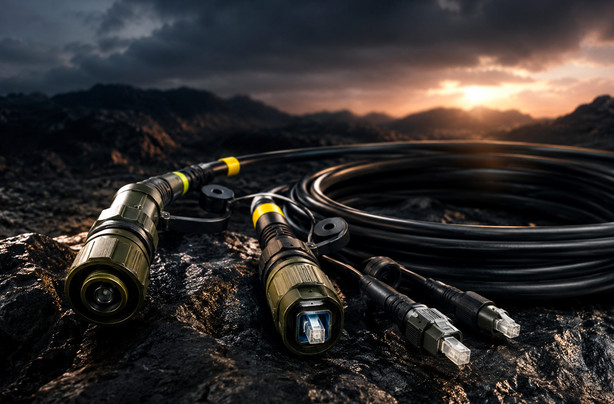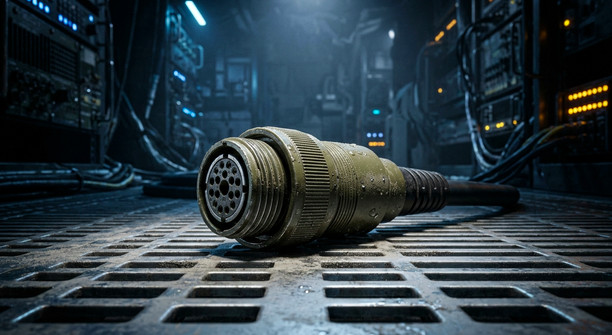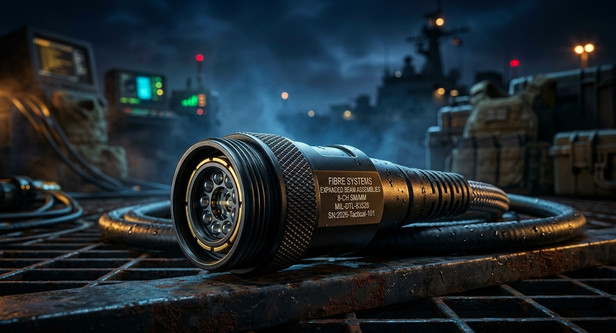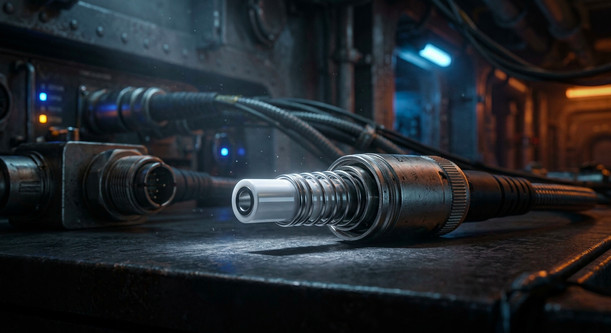
Fibre Optic Terminus Assemblies serve as the ultimate precision contact point for military, aerospace, and severe marine communications infrastructure. In high-density tactical enclosures, shipboard bulkheads, and heavy industrial machinery, traditional commercial optical connectors fail when subjected to continuous physical shock, severe mechanical vibration, and corrosive salt air. Fibre Systems designs and manufactures defence-grade terminus assemblies engineered to maintain sub-micron optical alignment under extreme physical stress, shielding critical assets from catastrophic communication blackouts.
The modern battlespace and industrial operational deck rely heavily on real-time, high-bandwidth optical data backbones. Weapons systems, radar arrays, subsea sonar networks, and autonomous mining haulers require continuous glass-to-glass contact across multi-pin circular connectors. When these systems encounter severe g-force shock or persistent engine deck vibration, standard spring-loaded optical connectors experience micro-separations. These transient physical gaps trigger optical signal disruption, leading to severe bit error rate spikes and immediate system offline faults. Deploying ruggedized Fibre Optic Terminus Assemblies prevents these physical gaps by providing rigid mechanical alignment and spring-tensioned stability.
Furthermore, deploying optical interconnects in unconditioned field environments amplifies physical wear and tear. Moisture, salt spray, and abrasive particulate ingress corrupt the delicate ferrule end-face. Without heavy-duty precision alignment mechanisms and hermetic sealing, microscopic grit smashes into the ceramic end-face during dynamic mating cycles. Modern Fibre Optic Terminus Assemblies are specially engineered with sealed housings and ceramic ferrules to repel corrosive contaminants.
In critical maritime and tactical applications, engineers specify Fibre Optic Terminus Assemblies to maintain stable insertion loss levels despite constant physical impact. Integrating high-spec Fibre Optic Terminus Assemblies ensures that sensitive multi-pin interfaces withstand severe environmental exposure without degrading core signal integrity. Ultimately, implementing military-grade Fibre Optic Terminus Assemblies is the foundation for absolute optical reliability in high-impact environments.
What Is a Fibre Optic Terminus Assembly?
A Fibre Optic Terminus Assembly is a high-precision, spring-loaded optical contact designed to fit into multi-pin circular or rectangular connectors (such as MIL-DTL-38999, MIL-PRF-28876, or ARINC 801 shells). Unlike standard standalone SC or LC patch connectors, a terminus functions as a removable, heavy-duty contact pin or socket insert that holds an individual optical fiber strand securely inside a multi-channel connector body. Incorporating ruggedized Fibre Optic Terminus Assemblies into complex military and maritime hardware protects delicate glass cores against harsh operational forces.
The core of high-performance Fibre Optic Terminus Assemblies consists of a precision ceramic (zirconia) or stainless steel ferrule, a high-tension internal spring, a precision guide sleeve, and a robust retention clip mechanism. This floating ferrule design ensures that when two multi-pin connectors mate, each individual terminus applies controlled, continuous physical contact force against its opposing ferrule.
This dynamic floating architecture is critical. By allowing individual optical termini to flex independently within the connector shell, Fibre Optic Terminus Assemblies absorb mechanical tolerances, thermal expansion, and structural flex without transferring damaging stress to the delicate glass core. Standardizing on high-grade Fibre Optic Terminus Assemblies helps field technicians maintain signal integrity during repeated mating cycles in severe environments.
Deploying precision Fibre Optic Terminus Assemblies transforms standard multi-pin electrical connector shells into high-density hybrid optical platforms. These modular contacts allow field engineers to blend power, copper signal, and high-speed fiber optic lines within a single ruggedized, IP68-rated environmental housing.
Common Challenges in Shock-Intensive and High-Vibration Environments
Maintaining uninterrupted optical data transfer across military hulls, aerospace platforms, and heavy mining machinery introduces extreme physical obstacles that overwhelm standard commercial connectors.
- Micro-Separations and Optical Disruption: High-impact shock events or engine deck vibration can overcome standard spring retention force, causing momentary physical separation between ferrule end-faces and resulting in instantaneous signal dropouts.
- Ferrule End-Face Pitting and Abrasion: Airborne dust, salt crystals, and fine metallic grit trapped inside unsealed connector housings grind against the polished glass end-face during dynamic vibration, causing permanent optical damage.
- Pin Misalignment and Alignment Sleeve Fracture: Heavy lateral shear forces can bend cheap guide pins or shatter rigid alignment sleeves, leading to catastrophic physical jamming and complete loss of channel connectivity.
- Thermal Expansion and Contraction Stress: Rapid temperature shifts in marine engine compartments cause materials to expand at different rates, introducing ferrule misalignment and high insertion loss.
- Salt Spray Corrosion and Moisture Ingress: Severe ocean environments penetrate non-cadmium or unsealed connector bodies, corroding internal retention clips and freezing the dynamic spring mechanism required for physical contact.
Integrating a robust Fibre Optic Terminus Assemblies infrastructure eliminates these failure points. By engineering each contact pin to withstand intense acceleration forces, tactical networks maintain consistent glass contact and low optical loss in any environment.
Technical Performance Standards for Defence-Grade Terminus Assemblies
Selecting optical terminus hardware requires a deep evaluation of mechanical tolerances, optical loss budgets, and military environmental specifications.
- Applicable Military Specifications: Manufactured to meet or exceed MIL-PRF-29504 (for MIL-DTL-38999 shells), MIL-PRF-28876 (naval shipboard), and ARINC 801 (commercial/military avionics) standards.
- High Mechanical Shock Resistance: Engineered to withstand extreme physical shock exceeding 300g (MIL-S-901D Grade A high-impact shock) without experiencing micro-separations greater than 50 nanoseconds.
- Continuous Vibration Endurance: Certified to withstand random vibration profiles from 20 Hz to 2,000 Hz at up to 50g acceleration without optical performance degradation.
- Low Insertion Loss Rating: Ultra-precision zirconia ferrules guarantee random mate insertion loss of less than 0.25 dB for singlemode and less than 0.15 dB for multimode architectures.
- High Return Loss (Reflectance): Precision APC (Angled Physical Contact) and UPC (Ultra Physical Contact) polishes deliver return loss figures exceeding 65 dB for singlemode applications.
- Operating Temperature Range: Extreme environmental rating covering minus 55 degrees Celsius to plus 165 degrees Celsius, maintaining mechanical spring force across total operational extremes.
- Mating Cycle Durability: Rated for over 500 mating cycles without degradation of optical loss or loss of retention clip force.
Comparison: Commercial LC/SC Connectors vs. Military Terminus Assemblies
Deploying commercial patch connectors in severe industrial or defense environments introduces unacceptable operational risk. The comparative table below outlines the structural differences and pastes cleanly into technical documentation.
| Technical Evaluation Criteria | Commercial LC / SC Connectors | Defence-Grade Terminus Assemblies |
| Housing Integration | Standalone plastic body | Multi-pin shell insert (MIL-DTL-38999) |
| Shock Resistance | Low (Prone to latch shear) | Extreme (Withstands 300g+ high-impact shock) |
| Vibration Damping | Minimal (Plastic latch flexes) | Internal floating spring & dynamic sleeve |
| Environmental Sealing | Unsealed or light boot | IP68 / Hermetic when mated in shell |
| Field Serviceability | Replace complete connector | Individual terminus extractable via tool |
| Hybrid Channel Support | Single-media only | Fiber, power, and copper in one shell |
| Ferrule Protection | Exposed ceramic ferrule | Recessed inside heavy metal shell cavity |
Commercial patch cords rely on thin plastic retention latches that easily snap under physical shock or foot traffic. In contrast, Fibre Optic Terminus Assemblies are seated inside thick aluminum, stainless steel, or marine bronze connector shells, transferring all structural loads away from the delicate optical fiber.
Additionally, individual terminus serviceability drastically reduces lifecycle maintenance costs. If a single fiber strand becomes contaminated or damaged, technicians use a specialized extraction tool to remove and replace that specific terminus contact without disturbing the surrounding optical channels inside the multi-pin connector body.
Mitigating Mechanical Shock and Vibration in Naval Shipboard Networks
Naval vessels represent one of the most mechanically demanding environments for optical cabling infrastructure. Constant hull flex, engine vibration, and the sudden kinetic shock of weapons fire place continuous stress on internal communication lines. Standard fiber connectors deployed near engine rooms or gun mounts suffer from fretting corrosion. This phenomenon occurs when micro-vibrations rub two mated ferrules together millions of times, creating fine ceramic dust that scatters laser light and degrades the signal budget. Integrating heavy-duty Fibre Optic Terminus Assemblies eliminates these operational vulnerabilities across shipboard data networks.
Modern Fibre Optic Terminus Assemblies utilize precision-calibrated stainless steel internal springs that maintain continuous, uniform contact pressure between ferrule end-faces regardless of external hull movement. This spring-loaded design enables Fibre Optic Terminus Assemblies to absorb kinetic energy, preventing ferrule separation and eliminating fretting wear. Furthermore, deploying rugged Fibre Optic Terminus Assemblies inside MIL-PRF-28876 shipboard connectors ensures that critical sonar, radar, and command data backbones survive high-impact shock events.
By isolating the glass core inside precision metal contacts, Fibre Optic Terminus Assemblies allow naval systems to maintain uninterrupted real-time situational awareness during high-stakes maneuvers. Naval defense engineers routinely specify Fibre Optic Terminus Assemblies to protect primary communications pathways against structural vibration. Modern shipyards rely on high-reliability Fibre Optic Terminus Assemblies to support dense multi-channel optical routing in compact spaces. Furthermore, standardizing on modular Fibre Optic Terminus Assemblies simplifies long-term maintenance routines for onboard technicians during active sea deployments. Ultimately, certified Fibre Optic Terminus Assemblies provide the ultimate optical connection integrity required for mission-critical maritime hardware.
Polishing Standards and Optical End-Face Geometry Optimization
Achieving ultra-low insertion loss and high return loss in heavy-duty terminus assemblies requires absolute control over ferrule end-face geometry during the field or factory polishing process.
Three critical geometric parameters dictate terminus performance:
- Radius of Curvature: The spherical measurement of the polished ferrule end-face. Controlled curvature ensures that physical contact occurs precisely at the fiber core center, optimizing light transfer.
- Apex Offset: The lateral distance between the highest point of the polished ferrule dome and the center of the optical fiber core. An excessive apex offset reduces core-to-core contact force, increasing insertion loss.
- Fiber Height (Undercut or Protrusion): The distance the optical glass core sits relative to the ceramic ferrule surface. Severe undercut creates an air gap that degrades return loss, while excessive protrusion increases the risk of glass chipping under heavy spring pressure.
Deploying automated multi-stage polishing machines utilizing diamond films is essential for achieving the strict geometry requirements of MIL-PRF-29504 termini. Precision end-face geometry guarantees that when connectors are locked under heavy coupling torque, physical contact is maintained across all operational temperatures.
Compliance with ACMA Regulations and Military Standards
Deploying optical interconnect hardware across Australian maritime vessels, defense assets, and commercial ports requires compliance with both international military specifications and national Australian regulations.
Adherence to the Australian Communications and Media Authority (ACMA) guidelines ensures that all fiber optic deployment hardware satisfies rigid electrical safety, flame retardancy, and structural integrity requirements. When optical fiber systems connect to onshore networks or commercial port infrastructure, components must satisfy ACMA Cabling Provider Rules (CPR) to prevent signal interference and hardware hazards.
Key compliance standards applicable to terminus assemblies include:
- AS/CA S008: Australian standard specifying safety and performance requirements for customer cabling products, ensuring materials are low-smoke zero-halogen (LSZH) compliant.
- MIL-DTL-38999 Series III: The benchmark specification for circular, tri-start threaded, high-density environmental connectors housing optical termini.
- MIL-PRF-29504 /4 & /5: Standardized specifications governing removable pin and socket termini for multi-pin connector shells.
- DEF(AUST) Specifications: Australian Defence Force standards governing maritime and land-based communications hardware reliability.
Ensuring your selected Fibre Optic Terminus Assemblies satisfy both ACMA rules and military defense standards guarantees that your optical network passes rigorous maritime survey inspections and delivers uncompromised tactical performance across Australian waters.
Step-by-Step Crimp, Termination, and Insertion of Optical Termini
Proper assembly techniques are critical for ensuring that high-density terminus contacts achieve their rated mechanical strength and optical performance.
Step 1: Cable Stripping and Outer Sheath Preparation
Utilize precision optical strippers to remove the outer cable jacket, aramid strength members, and primary buffer coating to the exact strip dimensions specified by the terminus manufacturer. Clean the bare fiber strand thoroughly using pure isopropyl alcohol.
Step 2: Epoxy Injection and Fiber Insertion
Inject high-temperature, optical-grade heat-cure epoxy into the terminus ferrule cavity using a micro-syringe. Carefully insert the prepared fiber strand until the buffer seats firmly inside the terminus body, ensuring a small, uniform epoxy bead forms at the ferrule tip.
Step 3: Crimp Aramid Strength Members and Heat Cure
Position the outer crimp sleeve over the aramid yarn and terminus tail. Crimp the sleeve using a calibrated hex crimp tool to provide mechanical strain relief. Place the assembly into a thermal curing oven set to the exact temperature profile required by the epoxy system.
Step 4: Multi-Step Precision End-Face Polishing
Mount the cured terminus into a precision polishing puck. Execute a multi-stage polishing sequence using silicon carbide and diamond lapping films down to 0.02 micron grit, continuously checking ferrule dome geometry and fiber height under an optical scope.
Step 5: Inspection and Connector Shell Insertion
Inspect the polished end-face using a digital fiber inspection scope to verify zero scratches, cracks, or pitting. Insert the completed terminus into the designated cavity of the multi-pin connector shell using an insertion tool until the internal retention clip clicks securely into place.
Field Maintenance, Cleaning, and Extraction Protocols
Establishing rigorous field maintenance protocols prevents latent contamination failure and extends the operational lifespan of heavy-duty terminus infrastructure.
- In-Shell Dry and Wet Cleaning: Clean recessed termini inside connector shells using specialized lint-free swab tools saturated with optical cleaning solvent. Never use standard cotton swabs, as micro-fibers will trap inside the retention sleeve.
- Digital End-Face Inspection: Inspect both pin and socket termini before mating using an extended-reach digital inspection scope capable of entering recessed MIL-DTL-38999 shell cavities.
- Terminus Extraction and Sleeve Replacement: If a channel shows elevated insertion loss, use a dedicated plastic extraction tool to compress the internal retention clip and slide the terminus out from the rear of the connector body. Replace the removable alignment sleeve inside the socket contact if contamination or damage is observed.
- Environmental Cap Management: Always install heavy-duty metal dust caps with lanyard retainers onto unmated connector shells immediately upon disconnection to prevent exposure to salt spray and dust.
Contamination remains the primary cause of signal degradation in military optical links. Unsealed connector shells collect microscopic salt crystals. When mated without cleaning, these hard particles crush the ceramic ferrule under spring pressure, permanently damaging the optical core.
Maintaining clean terminus contacts ensures low-loss transmission and protects costly transceiver electronics from back-reflections caused by end-face air gaps.
Integrating Terminus Assemblies into Aerospace and Unmanned Autonomous Systems
Unmanned Aerial Vehicles (UAVs), high-altitude defense platforms, and autonomous underwater vehicles (AUVs) place extreme spatial, weight, and vibration constraints on internal electronic payloads. Standardizing on specialized Fibre Optic Terminus Assemblies allows aerospace engineers to route high-definition video, sensor telemetry, and radar data over a compact, lightweight optical backbone inside miniature connector shells.
Deploying lightweight ARINC 801 or miniature MIL-DTL-38999 Fibre Optic Terminus Assemblies allows flight control systems to operate with maximum signal reliability under high-g maneuvers. Replacing heavy copper cabling bundles with multi-channel Fibre Optic Terminus Assemblies reduces harness weight by up to 70 percent, directly extending aircraft flight endurance and payload efficiency.
Furthermore, autonomous systems operating in high-vibration aerospace or subsea environments demand total immunity to Electromagnetic Interference (EMI). High-performance Fibre Optic Terminus Assemblies route high-speed data past high-voltage radar power supplies and propulsion motors without picking up noise or radiating signals that could compromise low-observable stealth profiles.
By integrating custom multi-channel connector systems into autonomous vehicles, defense contractors achieve unmatched data throughput, physical survivability, and environmental protection across all mission sectors.
Future-Proofing Heavy Industrial Networks with Modular Interconnects
As heavy manufacturing, mining, and oil and gas facilities integrate automated sensors, industrial robotics, and high-speed machine vision systems, traditional industrial Ethernet connectors are reaching their physical limits.
Installing modular multi-pin connectors equipped with Fibre Optic Terminus Assemblies future-proofs industrial infrastructure against harsh operational environments. These ruggedized platforms handle high physical impact, chemical exposure, and washdown pressures while supporting 10G, 40G, and 100G data links across factory floors.
Furthermore, utilizing hybrid terminus inserts allows facilities to run high-voltage AC power alongside multi-mode or singlemode fiber in a single heavy-duty cable assembly. This consolidation simplifies cable tray routing, reduces installation labor, and eliminates the spatial clutter associated with running separate power and communication lines.
Partnering with experienced optical engineering specialists ensures that your heavy industrial facility selects the exact shell plating, sealing gaskets, and terminus ferrules required to survive aggressive chemical exposure and continuous physical vibration over decades of service.
Frequently Asked Questions
What is the difference between a standard fiber connector and a optical terminus?
A standard connector (like an LC or SC) is an all-in-one plastic or metal plug designed for clean patch panels. An optical terminus is a precision, spring-loaded contact pin or socket that inserts into a multi-pin connector shell (such as MIL-DTL-38999), allowing multiple fiber channels, power, and copper to combine inside a single ruggedized housing.
How do terminus assemblies handle extreme physical shock and vibration?
Terminus assemblies feature internal high-tension springs that hold the ceramic ferrules together under continuous physical pressure. When the connector shell encounters heavy shock or vibration, the spring absorbs the mechanical movement, keeping the optical glass cores in constant physical contact and preventing signal dropouts.
Can individual damaged termini be replaced in the field?
Yes. Termini are held inside connector shell cavities by removable retention clips. Using a specialized insertion/extraction tool, a technician can release the clip from the rear of the connector and slide out an individual damaged terminus for cleaning, re-polishing, or replacement without replacing the entire multi-channel connector assembly.
What connector shells are most commonly used with optical termini?
The most common connector shells are MIL-DTL-38999 Series III (circular tri-start threaded), MIL-PRF-28876 (naval shipboard), ARINC 801 (avionics and aerospace), and EN4165. These shells provide IP68 environmental sealing, heavy EMI shielding, and robust mechanical coupling torque.
Why is end-face geometry inspection critical for military termini?
Because military termini operate under high spring retention forces to survive shock, any improper apex offset, incorrect radius of curvature, or fiber protrusion will concentrate physical pressure on a small point. This leads to glass cracking, ceramic pitting, and high optical insertion loss during dynamic temperature cycles.
Strategic Summary
- Fibre Optic Terminus Assemblies provide spring-loaded, precision optical contact inserts for multi-pin circular and rectangular ruggedized connector shells.
- Engineered to survive 300g+ shock events and intense random vibration, terminus hardware eliminates micro-separations and signal dropouts in naval and defense networks.
- Modular design allows individual pin and socket replacement, dramatically reducing long-term field maintenance costs and downtime.
- Full compliance with ACMA regulations, AS/CA S008 standards, and MIL-PRF-29504 specifications guarantees regulatory approval and tactical survivability across Australian projects.
- Hybrid shell capability enables seamless combination of high-speed optical channels, high-voltage power lines, and copper signals inside a single IP68 environmental connector housing.
Protect Your Critical Infrastructure with Defence-Grade Terminus Hardware Now
High-stakes defense, maritime, and heavy industrial assets cannot afford optical signal dropouts caused by mechanical shock, vibration, or severe environmental ingress. Deploying commercial connectors in tactical environments introduces catastrophic risks to mission-critical communications. Installing precision Fibre Optic Terminus Assemblies guarantees that your high-speed data pathways maintain Low Loss optical stability, physical durability, and absolute signal integrity in the most hostile operational environments on Earth.
Fibre Systems supplies accredited, military-grade optical interconnect hardware tailored specifically to the Australian defence, mining, and maritime sectors. Shield your critical communications infrastructure from physical failure by partnering with proven fiber optic technical specialists.
Contact our technical engineering team today to discuss your ruggedized connector requirements, or explore our full product range to discover precision optical hardware engineered for extreme environment deployment.