Mining fibre management is the essential process of organizing, securing, and protecting the fragile fibre optic pathways that serve as the backbone for mobile command centres and remote mining operations. In the demanding world of open-cut mining, space inside mobile units is a premium commodity, yet the demand for instantaneous, high-bandwidth data is absolute.
Without effective Mining fibre management, engineering teams are often left struggling with unorganized cable bundles that are susceptible to physical damage, difficult to troubleshoot, and prone to failure during critical production cycles. By implementing professional, rackmount sliding enclosures from Fibre Systems, project managers can evolve from chaotic, cramped connectivity to a streamlined, maintenance-friendly hub that keeps the entire site productive and connected.
Why Cable Clutter is a Silent Threat to Operational Efficiency
In any industrial setting, cable clutter is more than just an eyesore; it is a hidden operational risk. When you step into a mobile communication cabinet in a mining hub, seeing a “bird’s nest” of patch cords is a clear signal that your Mining fibre management is failing and the infrastructure is at risk. Unorganized cables lose their structural protection, and because every fibre core is delicate, repeated movement, snagging on other equipment, or unintentional kinking during routine maintenance often leads to micro-cracks in the glass.
In high-stakes mining, every minute of unexpected downtime translates to significant financial loss. When your connection infrastructure is tangled, troubleshooting becomes a labor-intensive chore for your technicians, but implementing proper Mining fibre management eliminates this chaos. It creates a controlled physical environment where your hardware is shielded from the vibrations, dust, and environmental fluctuations that are standard in mining locations. Ultimately, when your Mining fibre management is top-tier, the physical layer becomes a predictable, resilient asset that keeps your entire operation running without interruption.
How Rackmount Sliding Enclosures Change Your Workflow
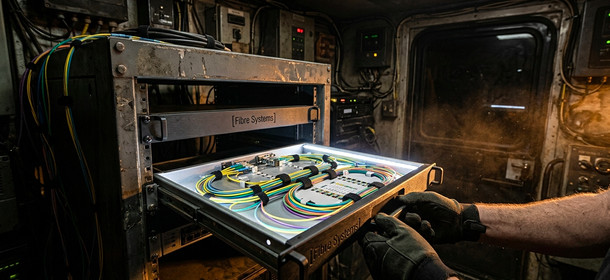
A sliding rackmount enclosure is the gold standard for Mining fibre management in mobile command units. Rather than treating your connection points as static, unreachable components at the back of a cabinet, a sliding tray brings the network directly to the technician. This “drawer-style” access is transformative for small-space management.
- Unobstructed Access: Technicians can fully extend the tray to perform splices, clean ports, or add new connections without disturbing adjacent cables.
- Strain Relief: The sliding mechanism incorporates gentle movement, preventing the sudden tugs or sharp bends that occur when trying to reach cables in fixed, crowded spaces.
- High-Density Potential: These enclosures are engineered to pack more connectivity into a small rack unit, which is vital when you are working within the limited footprint of a mobile container.
- Clear Administrative Mapping: With cables organized on a sliding tray, it becomes infinitely easier to label ports, map out paths, and ensure that every connection is accounted for during site audits.
Comparison: Standard Cable Storage vs. Dedicated Fibre Enclosures
| Feature | Loose Cable Bundles | Fibre Systems Sliding Enclosures |
| Accessibility | Poor; prone to tangling and snags | Excellent; slides out for direct access |
| Physical Protection | Vulnerable to crushing and kinking | Fully enclosed in rigid metal housing |
| Maintenance Time | High; requires manual untangling | Low; efficient and immediate |
| Signal Integrity | At risk due to micro-bends | Optimized with fixed bend-radius control |
Maintaining Signal Integrity in High-Vibration Mining Environments
One of the most persistent hurdles in Mining fibre management is the impact of vibration. Mobile mining command hubs are often situated near massive crushers, generators, and heavy-haul traffic, where ground-level vibrations can quickly compromise any subpar Mining fibre management strategy. These operations transmit kinetic energy directly into your server cabinets, which can be devastating for delicate optics.
When cables are loosely bundled, this constant vibration causes the individual strands to rub against one another or vibrate against metal edges. To overcome this, modern Mining fibre management must prioritize vibration isolation. Over time, poor management leads to connection fatigue and signal attenuation, which is why we emphasize that consistent Mining fibre management is vital for signal integrity.
By using Fibre Systems rackmount enclosures, you fix these connections within a shock-resistant, rigid housing. This environment dampens the vibration, ensuring that the light signal remains consistent, regardless of the intensity of the mining activities occurring just outside the unit. Ultimately, superior Mining fibre management is what differentiates a fragile, experimental setup from a truly industrial-grade network.
Step-by-Step: Organizing Your Mobile Command Hub
If your current mobile command setup is feeling overwhelmed by clutter, follow these steps to implement a more professional approach to Mining fibre management:
- Conduct a full network audit: Before touching anything, map out every cable. Label both ends clearly to ensure that the transition to an organized system does not result in accidental disconnects.
- Select the appropriate enclosure: Choose a sliding rackmount unit that fits your specific cabinet depth. Ensure it has enough port density to accommodate current equipment and expected future upgrades.
- Prioritize slack management: Utilize the integrated spool systems within the Fibre Systems enclosure to store excess patch cord length. This ensures you have enough cable for future repairs without it hanging loose where it can be snagged.
- Adopt re-usable cable ties: Replace permanent plastic zip ties with hook-and-loop fasteners. This allows you to add or remove cables in the future without the risk of cutting into the cable jacket with wire cutters.
- Perform final validation: After the hardware is reorganized, always conduct a final insertion loss test. This confirms that your re-routing has not introduced any hidden bends that degrade signal performance.
Frequently Asked Questions on Mining Fibre Management
How does sliding rackmount hardware help in a mine site?
Sliding enclosures provide immediate access to connections in confined spaces, drastically reducing repair times and preventing the accidental damage often caused by cramped, fixed-panel setups.
Why is cable organization important for signal quality?
Poor Mining fibre management forces cables into tight corners or creates strain, both of which cause “insertion loss.” This reduces data throughput and is a common cause of intermittent network drops.
Can Fibre Systems help with custom mobile setups?
Yes, Fibre Systems specializes in ruggedized, industrial-strength hardware designed to endure the environmental challenges unique to the Australian mining landscape.
What is the benefit of hook-and-loop fasteners over zip ties?
Hook-and-loop fasteners are infinitely reusable and apply gentle pressure, avoiding the risk of pinching or crushing the delicate glass fibre cores that occurs when plastic zip ties are pulled too tight.
Are these enclosures dust-proof?
These enclosures are built for harsh industrial environments, featuring high-quality seals and rugged materials that effectively block dust, debris, and moisture from compromising your optical connections.
Building a Future-Proof Mobile Network
Your mobile command hub acts as the brain for your entire site operation. When that environment is disorganized or difficult to maintain, your engineers are effectively working with one hand tied behind their backs. By prioritizing Mining fibre management, you are not just cleaning up a room; you are securing the long-term reliability of your data.
Fibre Systems provides the rugged, industrial-strength solutions required to turn a mobile container into a world-class network hub. Effective Mining fibre management is the foundation of this setup, as our high-density sliding enclosures and advanced patch panels ensure your hardware stays clean, accessible, and ready for deployment. Stop letting minor cable issues dictate your site production and see how proper Mining fibre management allows you to invest in a physical layer that works as hard as your mining equipment.
Summary of Mobile Fibre Connectivity
- Mining fibre management is a fundamental requirement for maintaining signal integrity within the cramped spaces of mobile mining units.
- Sliding rackmount enclosures are the most effective way to provide physical protection while maintaining easy access for maintenance teams.
- Properly managed slack and secure routing prevents micro-bending, which is a leading cause of signal degradation.
- Fibre Systems offers specialized, ruggedized hardware engineered to withstand the extreme environmental stresses of the mining sector.
Request a custom quote for your next industrial project by contacting the Fibre Systems team.
View the full range of Fibre Systems tactical solutions designed for the mining and industrial sector.
Visit the Fibre Systems portal to learn more about our commitment to industrial reliability.
For more information on industrial cabling standards, you can refer to the ACMA Technical Cabling Rules.