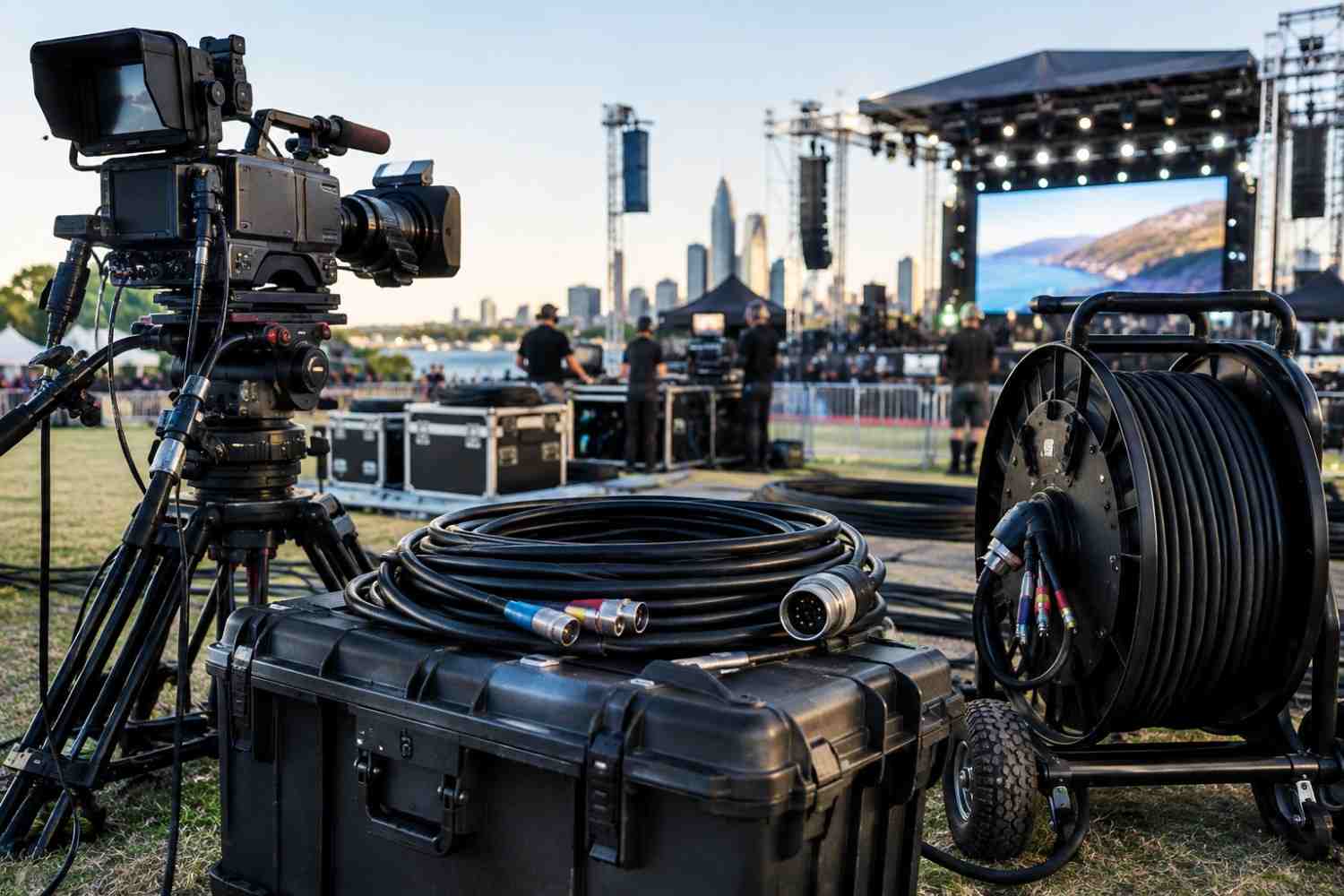
Broadcasting from a live event, sports venue, concert or outside broadcast location comes with very different networking requirements from a permanent studio. Equipment needs to be connected quickly, signals need to remain reliable and cabling has to cope with repeated setup, pack-down and transport.
This is where tactical and hybrid fibre solutions can make a practical difference. A well-designed field fibre system can carry high-bandwidth signals over long distances while providing the durability required for demanding production environments.
For broadcasters, production companies and outside broadcast teams looking to buy tactical fibre reel systems, choosing the right cable construction, fibre type and connectivity equipment is essential. Options such as hybrid broadcast fibre cable and singlemode broadcast cabling can be selected according to the application, distance and equipment being used.
What Are Tactical Fibre Solutions for Broadcast?
Tactical fibre solutions are designed for temporary and mobile network installations where cables need to be deployed, used and packed away regularly. Unlike standard indoor fibre cabling, tactical cable assemblies are built with field use in mind.
They are commonly used for outside broadcasts, sporting events, live entertainment, festivals and temporary production sites where permanent cabling is not practical.
A tactical fibre setup can include:
- Tactical fibre reels
- Ruggedised fibre cables
- Fibre breakout assemblies
- Optical connectors
- Patch leads
- Fibre termination equipment
- Storage and transport accessories
The exact configuration depends on the broadcast equipment, transmission distance and type of production.
Why Is Fibre Important for Broadcast Field Work?
Modern broadcasts can involve multiple high-bandwidth signals, including cameras, audio, intercoms, monitoring systems and production communications. Running all these connections reliably across a temporary site requires suitable infrastructure.
Fibre can carry large amounts of data over long distances while remaining relatively lightweight compared with some copper alternatives. It is also not affected by electromagnetic interference in the same way as electrical cabling.
For field production crews, this can make fibre a practical choice when equipment is spread across a venue or production area.
What Is a Tactical Fibre Reel?
A tactical fibre reel is a purpose-designed cable storage and deployment system containing a ruggedised fibre cable. The reel allows production crews to transport, deploy and retrieve the cable more efficiently.
Rather than carrying loose lengths of fibre that can become difficult to manage, a reel provides a controlled way to store the cable between productions.
When choosing a system to buy tactical fibre reel equipment, consider the required cable length, fibre type, connector configuration, reel construction and intended working environment.
What Should You Look for in a Tactical Fibre Reel?
The right reel depends on how and where the production team will use it. Important considerations include:
- Cable length
- Fibre type
- Connector configuration
- Reel size and construction
- Cable protection
- Deployment requirements
- Transport and storage needs
- Compatibility with broadcast equipment
A reel intended for regular outside broadcast work needs to be practical to transport and capable of handling repeated deployment and retrieval.
What Is a Hybrid Broadcast Fibre Cable?
A hybrid broadcast fibre cable combines optical fibre with additional conductors within a single cable assembly. The exact construction depends on the manufacturer and intended broadcast application.
This type of cable can reduce the number of separate cables required between production equipment and remote locations. Depending on the design, a hybrid cable may support combinations of signal transmission, power and other production requirements.
For mobile production teams, combining multiple functions into one cable can simplify deployment and cable management at busy venues.
Where Are Hybrid Broadcast Cables Used?
Hybrid cable systems can be useful in applications where cameras and other production equipment need to be connected to a central production area.
Typical applications can include:
- Outside broadcasts
- Sporting events
- Concerts and festivals
- Live television production
- Studio-to-field links
- Temporary production sites
The cable specification should always be matched to the equipment and the signals being carried.
What Is Singlemode Broadcast Cabling?
Singlemode broadcast cabling uses single-mode optical fibre, which is designed to transmit optical signals over longer distances with appropriate equipment.
It can be suitable for broadcast environments where camera positions, production areas and technical facilities are separated by significant distances. Depending on the equipment and optical specifications, single-mode fibre can support high-bandwidth links across venues and production sites.
Before selecting singlemode cabling, production teams should confirm that the cameras, converters, optical transceivers and other equipment are compatible with single-mode fibre.
Singlemode vs Multimode Fibre for Broadcast
The choice between single-mode and multimode fibre depends on the production requirements and equipment being used.
Single-mode fibre is generally associated with longer transmission distances and is commonly considered when a production requires links across larger venues or between separate locations.
Multimode fibre can be suitable for shorter links where compatible broadcast equipment supports it.
There is no single option that suits every production. The transmission distance, equipment interfaces, optical specifications and required bandwidth should be considered before selecting the cable.
What Are the Benefits of Tactical Fibre for Outside Broadcasts?
Field production puts additional demands on network cabling. Equipment may need to be moved between venues, cables may be deployed across temporary routes and production crews often have limited time to establish the connection.
Tactical fibre can help address these practical requirements.
Designed for Repeated Deployment
Tactical cable assemblies are intended for field use and can be stored on reels or other suitable systems between productions. This makes them practical for teams that regularly set up and pack down temporary networks.
Supports Long Cable Runs
Fibre can carry optical signals over considerable distances when used with suitable equipment. This makes it useful when cameras or production systems are positioned well away from the main technical area.
Helps Reduce Cable Clutter
Hybrid cable designs can combine different functions within a single cable assembly. This can simplify cable runs and reduce the number of separate cables required in some broadcast applications.
Suitable for Mobile Production
A properly selected tactical fibre system can be transported between venues and deployed as part of a repeatable field production setup.
How Do You Choose the Right Tactical Fibre Cable?
Choosing a tactical fibre cable starts with the production requirements rather than the cable alone.
Consider where the cable will be used, how far the signal needs to travel and what equipment will be connected at each end. The cable construction should also suit the way your production team handles and transports its equipment.
Key considerations include:
- Required cable length
- Single-mode or multimode fibre
- Required bandwidth
- Connector type
- Equipment compatibility
- Environmental conditions
- Frequency of deployment
- Storage and transport requirements
Checking these details before purchasing can help avoid compatibility problems once the production is on site.
How Does a Tactical Fibre Reel Improve Field Deployment?
A reel provides a practical way to manage long lengths of tactical cable. Instead of manually handling a loose cable, crews can deploy the required length from the reel and retrieve it once the production is finished.
This can make cable management more straightforward, particularly when several connections need to be installed around a venue.
A suitable reel should allow the cable to be deployed without placing unnecessary strain on the fibre. Following the manufacturer’s instructions for deployment, winding and storage is important for protecting the cable assembly.
What Should You Consider When Buying Broadcast Fibre?
Buying broadcast fibre is not simply about selecting the longest cable or the lowest-priced option. The cable needs to suit the equipment, transmission requirements and working conditions.
Before placing an order, check the fibre specification, connector type, cable construction and required length. If a hybrid cable is being considered, confirm exactly which functions the cable is designed to carry.
It is also worth checking whether replacement assemblies, compatible connectors and other accessories are available. This can be particularly useful for production companies maintaining equipment for multiple events.
How Can Broadcast Fibre Be Maintained?
Proper handling is important for any fibre cable, particularly one that is regularly transported and deployed.
Cable assemblies should be stored correctly when not in use, connectors should be protected from contamination, and the cable should not be bent beyond its specified limits.
Production crews should also inspect tactical cables before and after major events. Look for visible damage, worn outer jackets, connector issues, and signs that the cable may have been subjected to excessive tension.
Regular inspection can help identify potential problems before the next production.
Common Problems With Broadcast Fibre Cabling
Fibre connectivity problems can cause significant disruption during a live production, so it is useful to understand some common causes.
Dirty connectors can affect optical performance, while excessive bending or physical damage may affect signal transmission. Incorrect connector types or incompatible equipment can also prevent a link from operating correctly.
When troubleshooting, start with the physical connection. Check the connectors, cable route, and equipment interfaces before moving on to more detailed testing.
Having spare compatible cables and connection components available can also be useful for time-sensitive productions.
Where Can Tactical Fibre Solutions Be Used?
Tactical fibre is particularly useful where a temporary high-bandwidth connection needs to be established quickly.
Applications can include:
- Sports broadcasting
- Live concerts
- Music festivals
- Corporate events
- Outside broadcast vehicles
- Television production
- Temporary production facilities
- Large-scale public events
The required cable and connector configuration will vary according to the equipment and production setup.
How to Choose a Broadcast Fibre Supplier
A suitable supplier should be able to provide clear technical information about the fibre products they supply. This includes cable construction, fibre type, connector options, available lengths, and application requirements.
For professional broadcast operations, it can also be useful to consider product availability, custom cable options, replacement components, and technical support.
If you regularly work across different venues, choosing a supplier that can provide consistent cable assemblies and compatible accessories may make equipment management easier.
Final Thoughts: Choosing Fibre for Broadcast Field Work
Broadcast field work demands cabling that can keep up with both the technical requirements of modern production and the practical realities of working at different venues. Tactical fibre solutions can provide high-bandwidth connectivity while offering a practical approach to transporting and deploying cable between productions.
If you are looking to buy tactical fibre reel equipment, consider the cable length, fibre type, connectors, reel construction, and compatibility with your broadcast systems. For more demanding setups, a hybrid broadcast fibre cable can combine multiple functions into a single cable assembly, while singlemode broadcast cabling can provide a suitable option for longer-distance fibre links.
The right solution will ultimately depend on your equipment, production setup and working environment. Taking the time to check these requirements before purchasing can help your production team establish reliable connections and avoid unnecessary equipment issues in the field. Contact us if you need help selecting tactical fibre reels, hybrid broadcast fibre cable, or singlemode broadcast cabling.
FAQs
What is a tactical fibre reel?
A tactical fibre reel is a cable storage and deployment system designed to make long, ruggedised fibre cables easier to transport, deploy and retrieve during field productions.
What is a hybrid broadcast fibre cable?
A hybrid broadcast fibre cable combines optical fibre with additional conductors in one cable assembly, depending on its design and intended broadcast application.
What is singlemode broadcast cabling used for?
Singlemode broadcast cabling is commonly used for longer-distance optical connections where compatible broadcast equipment requires single-mode fibre for signal transmission.
How do I choose a tactical fibre cable?
Consider the required length, fibre type, connectors, bandwidth, equipment compatibility, deployment conditions, and how frequently the cable will be transported and reused.
Are tactical fibre reels suitable for outside broadcasts?
Yes. Tactical fibre reels are designed to make ruggedised fibre cables easier to transport, deploy and retrieve, making them suitable for many temporary broadcast environments.