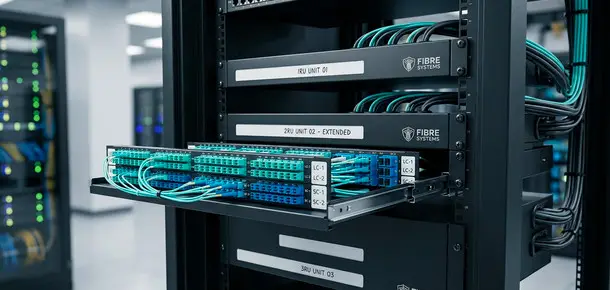
Multi-Port Rackmount Enclosures allow data centers and network backbones to scale optical density rapidly without any downtime or configuration headaches.
Designed as high-density hubs, these chassis streamline multi-fiber links within standard server footprints. Supplied by infrastructure expert Fibre Systems, these modular systems eliminate the clutter often caused by rigid terminal trays.
In high-throughput environments, engineering teams need seamless scalability. These units help architects plan, deploy, and modify fiber networks effortlessly, ensuring maximum availability during expansions.
When planning high-density updates, managing massive fiber counts in limited rack space is a challenge. Standard boxes often cause congestion and high labor costs, but transitioning to our multi-tier architecture keeps your ports organized, accessible, and ready for any scaling demand.
Multi-Port Rackmount Enclosures: Solving Scaling Friction and Port Access Delays
In massive enterprise campus networks, colocation server environments, and sprawling cloud distribution facilities, infrastructure specialists face intense pressure during strict maintenance windows. The classic data center challenge involves scaling up a central switching hub using Multi-Port Rackmount Enclosures to handle increased user traffic without downtime.
Because standard low-capacity patch trays lack modular versatility, technicians often struggle when adding new lines. By upgrading to Multi-Port Rackmount Enclosures, you eliminate the need to shift existing active trunk links. This prevents the physical strain often caused by cheaper hardware, as Multi-Port Rackmount Enclosures are designed to protect live ports from accidental disconnection.
Using Multi-Port Rackmount Enclosures turns a routine capacity upgrade from a high-stress troubleshooting session into a seamless process. Furthermore, a lack of clear vertical design in standard racks creates long-term hazards, which is why Multi-Port Rackmount Enclosures are essential for modern server rooms.
When a framework lacks integrated bend-radius guides, routing patch links leads to sagging fiber bundles. Multi-Port Rackmount Enclosures solve this by providing dedicated vertical spacing and clear cable management. This accessibility ensures that, even in dense environments, Multi-Port Rackmount Enclosures keep port identification fast during critical outages.
Technicians no longer need to wrestle with unmanageable masses of cabling when they standardize on Multi-Port Rackmount Enclosures. Adopting this heavy-duty framework of Multi-Port Rackmount Enclosures completely eliminates dangerous guesswork from your network footprint. Ultimately, investing in these Multi-Port Rackmount Enclosures ensures your infrastructure safely supports continuous growth. If you are looking for the most reliable, long-term solution, Multi-Port Rackmount Enclosures remain the industry standard for high-performance data centers.
Technical Scope and Modular Versatility of the 1RU, 2RU, and 3RU Lineup
The core advantage of the Multi-Port Rackmount Enclosures centers around a highly flexible, multi-variant chassis architecture designed to fit any space requirement or density goal seamlessly. Rather than forcing network managers to use mismatched, single-row brackets that waste valuable server space, this product lineup offers distinct 1RU, 2RU, and 3RU footprints to match your specific scaling goals. By utilizing interchangeable internal adapter modules and smooth telescoping trays, a single standardized enclosure framework easily adapts to handle modern high-speed LC duplex layouts, classic SC subscriber links, or robust metallic ST bayonet connections within a unified framework.
The 1RU Configuration: Optimized Density for Edge Switching Racks
The compact 1RU variant is engineered specifically for space-limited edge cabinets, top-of-rack distribution setups, and local network closets where every single rack unit is highly valuable. Despite its slim profile, this precision-engineered enclosure utilizes advanced high-density spacing to support up to three independent sliding adapter plates or plug-and-play MTP/MPO cassettes. This intelligent structural design provides a high port capacity while maintaining full bend-radius safeguards, making it the perfect choice for high-speed edge uplinks that require absolute structural stability within a highly compact physical footprint.
The 2RU Configuration: The Ideal Balance for Balanced Enterprise Distribution
For centralized corporate networks and mid-tier distribution setups that need a balance between high port capacity and comfortable maintenance access, the 2RU enclosure is the ideal professional solution. This dual-row chassis configuration supports up to six modular adapter plates, providing double the port capacity without putting unmanageable stress on incoming outdoor trunk cables. The increased internal chassis depth offers extra breathing room for storing fiber loops and managing incoming splice sleeves, making it a favorite asset for engineering teams who manage steady network growth alongside routine physical link audits.
The 3RU Configuration: Heavy-Duty Capacity for Core Data Center Backbones
The massive 3RU enclosure represents the ultimate standard in high-density optical patching, purposefully built for main distribution areas, cloud data center cores, and massive carrier exchange hubs. This high-capacity distribution chassis houses up to twelve interchangeable adapter plates or high-density cassettes, allowing for the centralized management of hundreds of active fiber links in a single robust footprint. Built with heavy-gauge steel and featuring advanced front and rear access pathways, the 3RU variant manages extensive backbone routing seamlessly, ensuring maximum uptime for long-term enterprise operations.
Technical Performance Matrix: Spatial and Port Density Profiles
| Structural Specification | 1RU Compact Enclosure | 2RU Balanced Chassis | 3RU High-Density Hub |
| Max Adapter Module Capacity | Up to 3 Adapter Plates | Up to 6 Adapter Plates | Up to 12 Adapter Plates |
| Primary Deployment Focus | Edge Switching / Top-of-Rack | Mid-Tier Distribution | Core Backbone Nodes |
| Chassis Drawer Mobility | Single Frictionless Slide | Independent Dual-Row Slides | Multi-Tier Modular Drawers |
| Internal Slack Storage Area | Compressed Rear Guide Track | Generous Center Loop Tray | Expanded Multi-Level Tray |
| Structural Frame Material | Heavy-Gauge Matte Steel | Heavy-Gauge Matte Steel | Heavy-Gauge Matte Steel |
Multi-Port Rackmount Enclosures: Streamlining Australian Data Center Lifecycles
The tight space limits of modern metropolitan data center hubs and enterprise server enclosures mean that wasted rack space translates directly into higher infrastructure operational overhead. To solve this, Multi-Port Rackmount Enclosures provide the spatial efficiency required to keep your facility scaling costs under control. By integrating Multi-Port Rackmount Enclosures into your setup, you ensure maximum port density per rack unit without sacrificing safety.
Whether you are managing a massive enterprise financial network in Sydney or upgrading a remote node in Brisbane, Multi-Port Rackmount Enclosures provide the structural reliability needed for high-density traffic. In high-demand automated environments, a single configuration error can stall vital cloud connections. Fortunately, Multi-Port Rackmount Enclosures help operators avoid these risks through superior design. Relying on Multi-Port Rackmount Enclosures allows your team to utilize integrated cable management hooks for seamless, efficient patching.
Furthermore, Multi-Port Rackmount Enclosures feature clear, permanent labeling blocks that make instantaneous link tracing possible. The smooth integration of Multi-Port Rackmount Enclosures with internal slack storage ensures that extra cable length winds away cleanly, preventing distortions on active terminal points. As data demands grow, upgrading to Multi-Port Rackmount Enclosures becomes the standard for preventing physical cable drag during fast reconfigurations.
Many facilities have found that Multi-Port Rackmount Enclosures are the most effective way to eliminate downtime during expansion. When you standardize your hardware with Multi-Port Rackmount Enclosures, you are investing in a future-proof network architecture. Ultimately, Multi-Port Rackmount Enclosures are the best choice for any team aiming to maximize both uptime and physical rack efficiency.
Securing High-Speed Optical Highways for Next-Generation Services
As enterprise networks transition to ultra-fast terabit automation backbones and high-density multi-fiber connectivity, guarding against physical decibel (dB) loss is absolutely non-negotiable. Modern high-speed optical transceivers used in industrial switches are highly sensitive to back-reflections and minor physical misalignments caused by external cabinet strain. Housing your connection points inside the Multi-Port Rackmount Enclosures keeps your optical fibers operating within precise, stress-free parameters, maximizing your transmission budget across every single data center terminal row.
Standardizing your industrial communications infrastructure with these compact modular assets also takes the complexity out of ongoing field maintenance and system training. When field teams have a dedicated, perfectly organized platform to handle complex field updates, completely removing the need for custom cable configurations or makeshift routing guides, human installation error drops to zero. This absolute level of hardware dependability is precisely why tier-one industrial automation networks and factory infrastructure specialists choose these advanced, integrated patching solutions to protect their critical data links.
Frequently Asked Questions Regarding Multi-Port Enclosures
What are the main capacity differences between the 1RU, 2RU, and 3RU variants?
The variants dictate the vertical rack unit space and module capacity. The 1RU handles up to 3 modular adapter plates for edge environments, the 2RU supports up to 6 plates for mid-tier distribution, and the heavy-duty 3RU accommodates up to 12 plates for massive core data center backbones.
How do multi-port enclosures prevent cable strain during high-density scaling?
Each enclosure incorporates independent, frictionless telescopic sliding trays and integrated internal routing wheels. When adding new fiber links, technicians slide the targeted tray forward smoothly without pulling or applying physical tension to neighboring active connection lines.
Can I deploy a mix of LC, SC, and ST connectors within a single rackmount chassis?
Yes, the advanced modular architecture uses interchangeable internal adapter plates. This allows you to combine high-density LC duplex lines, classic SC connectors, and robust ST bayonet links inside a single chassis footprint, protecting your long-term infrastructure investment.
Summary of Enterprise Modular System Advantages
- Optimized Rack Space Efficiency: Packs maximum port density into 1RU, 2RU, and 3RU options to prevent wasted cabinet real estate.
- Frictionless Sliding Accessibility: Independent telescopic tracks allow for safe maintenance access without disturbing active adjacent ports.
- Multi-Format Technical Versatility: Full compatibility with interchangeable LC, SC, and ST adapter plates within a unified chassis.
- Premium Structural Durability: Built with heavy-gauge reinforced steel to resist physical chassis distortion inside heavy server racks.
- Advanced Cable Management: Integrated strain-relief rings and bend-radius guides eliminate cable sagging and port clutter.
Future Proofing Enterprise Core Networks Against Lifecycle Demands
Investing in premium, data-center-grade optical hardware is an absolute commitment to ensuring the long-term operational health, agility, and readiness of your enterprise networks. Whether your current project demands rapid fiber density expansion across a high-demand manufacturing facility or highly organized, robust port protection within complex automated industrial hubs, the structural efficiency of advanced patch management yields exceptional long-term returns. By incorporating the Multi-Port Rackmount Enclosures into your standard infrastructure blueprints, you ensure your physical layer network remains completely secure, organized, and fully operational through any scaling milestone.
Explore the complete lineup of Fibre Systems enterprise assets engineered for high-density environments by navigating to our official products section.
To request a specialized engineering blueprint quote or to consult with an infrastructure specialist regarding your upcoming industrial network upgrade, visit our official Fibre Systems Contact Us Page today.
For further information regarding national telecommunications infrastructure benchmarks and official network cabling safety standards across Australia, consult the regulations set by the ACMA Technical Cabling Rules.