Industrial Media Converters: The Bridge Between Legacy Copper and the 2026 Fibre Revolution
Industrial media converters are the essential tactical tools for any facility manager looking to modernize their communication backbone without the massive capital expense of a total infrastructure “rip and replace.” In 2026, many Australian industrial sites and processing plants are still tethered to aging copper-based Ethernet systems that simply cannot keep up with the data-intensive demands of modern AI-driven monitoring and remote automation. Fibre Systems provides a strategic pathway for these legacy environments, allowing you to integrate high-speed fibre optic links into your existing copper network seamlessly and affordably.
What are Industrial Media Converters?
An industrial media converter is a ruggedized networking device designed to translate signals between two different media types, typically from a standard copper-based RJ45 Ethernet port to a high-speed fibre optic link. These devices act as a “universal translator” for your network, allowing you to extend the reach of your data far beyond the 100-meter physical limit of copper cabling. By utilizing a media converter from Fibre Systems, you can transmit critical data across several kilometres using fibre, then convert it back to copper at the local device level, effectively future-proofing your site one link at a time.
The Copper Ceiling: Why Legacy Systems are Failing in 2026
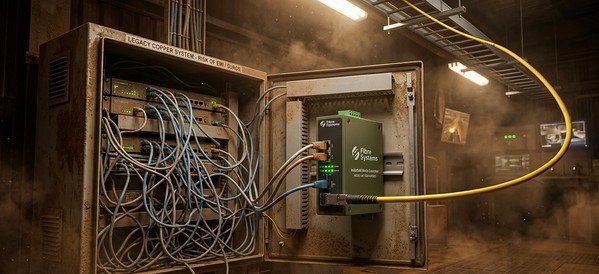
The primary pain point for older industrial facilities is the “Copper Ceiling.” Legacy Category 5e or Cat 6 cabling was never designed to handle the 2026 reality of high-definition 4K surveillance, autonomous vehicle telemetry, and real-time sensor arrays. Copper is also highly susceptible to Electromagnetic Interference (EMI) and lightning strikes, which are common hazards in large-scale Australian mining and manufacturing zones. If your network is plagued by intermittent drops or “slow” data transfers, you are likely hitting the physical limitations of your old copper wiring.
Fibre Systems solves this by offering industrial media converters that allow you to “cherry-pick” your most critical long-distance links for an immediate fibre upgrade. Instead of spending millions of dollars to pull out kilometers of copper from underground conduits or overhead trays, you simply install a converter at each end of a new fibre run. This allows you to maintain your existing copper switches and end-devices while enjoying the massive bandwidth and EMI immunity that only fibre optics can provide.
Strategic Migration: The “Fix What is Broken” Approach
In a high-pressure industrial environment, a total system shutdown for a network overhaul is an operational nightmare. Industrial media converters allow for a “phased migration” strategy. You can start by replacing your most vulnerable or slowest links, perhaps the ones running near high-voltage motors or across exposed outdoor areas while keeping the rest of your copper infrastructure intact. This modular approach from Fibre Systems allows you to manage your budget and your maintenance windows more effectively, ensuring that your transition to a 2026-standard network is a smooth evolution rather than a disruptive revolution.
| Network Feature | Legacy Copper Ethernet | Fibre Systems Hybrid (with Converters) |
| Max Distance | 100 Meters (Hard Limit) | Up to 80+ Kilometres (Scalable) |
| EMI Resistance | Poor (Prone to noise/interference) | Total Immunity (Fibre is non-conductive) |
| Lightning Safety | Vulnerable (Conducts surges) | Safe (No electrical path between sites) |
| Upgrade Cost | Very High (Total replacement) | Low (Strategic, link-by-link upgrade) |
| Bandwidth | Limited (Bottleneck for 2026 AI) | High (Ready for 400G and beyond) |
Why “Industrial Grade” is Non-Negotiable
You might be tempted to use a cheap, office-grade media converter to save costs, but in a harsh environment, this is a recipe for disaster. Standard converters are not built to handle the vibration, dust, and extreme temperature swings of a typical Australian worksite. Industrial media converters from Fibre Systems are engineered with ruggedized metal housings, fanless cooling, and high-tolerance internal components that can operate in temperatures ranging from -40 to +75 degrees Celsius.
Our converters also feature redundant power inputs and DIN-rail mounting, ensuring they fit perfectly into your existing industrial control cabinets. This mechanical toughness ensures that your new “fibre bridge” is just as resilient as the copper hardware it is replacing. When you use Fibre Systems, you are installing a solution that is built to survive the brutal reality of the Pilbara or the humidity of the Northern Territory, not just a climate-controlled server room.
Extending the Life of Your Expensive Legacy Hardware
Many industrial facilities are running PLC (Programmable Logic Controller) systems and specialized sensors that were incredibly expensive to install and are still perfectly functional, despite having only copper interfaces. Ripping these out just to get a fibre connection is financially irresponsible. Industrial media converters allow you to keep these legacy assets in service for years to come. By “wrapping” your old copper ports in a fibre link, you give them the range and reliability they need to function in a modern, data-driven environment.
Fibre Systems specializes in providing these “lifeline” solutions for the Australian mining, resource, and energy sectors. We understand that in 2026, the goal is maximum ROI. By using our industrial media converters, you are protecting your previous investments while gaining the benefits of modern optics. It is the smartest way to bridge the gap between the reliable past and the high-speed future.
Frequently Asked Questions About Copper-to-Fibre Migration
Do I need a special type of fibre for industrial media converters?
Most industrial media converters from Fibre Systems utilize SFP (Small Form-factor Pluggable) ports. This means you can choose between Multimode fibre for shorter distances within a plant or Singlemode fibre for long-distance links spanning several kilometres. This flexibility allows you to customize the hardware to your specific site layout.
How do I manage the power for converters located in remote areas?
Fibre Systems offers converters with wide-range DC power inputs (typically 12 to 48VDC) which are standard in most industrial control panels. We also provide Power over Ethernet (PoE) options, where the converter can actually provide power to a local copper device (like a surveillance camera or a wireless access point) through the same RJ45 cable it is converting to fibre.
Will using a media converter increase my network latency?
The latency introduced by an industrial media converter is microscopic measured in nanoseconds. For the vast majority of industrial applications, including real-time PLC communication and video streaming, the difference is completely unnoticeable. In fact, the overall network performance usually improves because the fibre link is immune to the signal-degrading EMI that often slows down legacy copper lines.
What happens if the fibre link goes down? How do I troubleshoot?
Fibre Systems converters often feature “Link Fault Pass-Through” (LFP). This is a critical safety feature where, if the fibre link fails, the converter will automatically shut down the copper port as well. This alerts your main network switch to the failure immediately, allowing your redundant failover systems to take over without delay.
Evolving Your Infrastructure with Fibre Systems
The journey from legacy copper to a modern fibre backbone does not have to be a multi-million dollar headache. By strategically deploying industrial media converters, you can reclaim your network speed, eliminate interference, and extend the life of your facility’s hardware.Fibre Systems is proud to be the trusted partner for Australian industries, providing the “missing links” that make high-speed migration possible for everyone, not just those with unlimited budgets.
Don’t let your old copper wiring be the bottleneck that holds your business back from the AI and automation breakthroughs of 2026. Secure your signal, protect your investments, and build a bridge to a faster tomorrow with the rugged reliability of Fibre Systems.
Ready to start your phased network upgrade?View our full range of industrial media converters and SFP modules. You can also request a technical consultation to see how we can bridge your legacy system into the future.
Summary of Tactical Benefits:
- Cost-Effective Migration: Upgrade to fibre link-by-link without replacing existing copper hardware.
- Extended Range: Break the 100-meter copper limit and transmit data over several kilometres.
- EMI and Surge Protection: Isolate your critical equipment from electrical noise and lightning strikes.
- Industrial Durability: DIN-rail mountable, fanless design for extreme Outback temperatures.
- Rapid Deployment: Simple “plug and play” setup with Link Fault Pass-Through for easy troubleshooting.