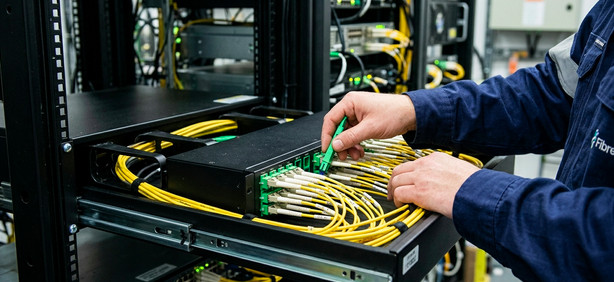
19 Inch Sliding Patch Panels are high density mechanical enclosures designed to house and organize fibre optic terminations while providing a smooth telescopic drawer action for easy internal access. These systems allow technicians to slide the tray forward to service specific connectors without the risk of snagging or disconnecting adjacent live cables. At Fibre Systems, we view these panels as the essential insurance policy for any data centre or industrial rack where an accidental unplug could mean a catastrophic network outage. You can explore our full range of 19 Inch Sliding Patch Panels to see how we prioritize network uptime in every design.
The High Stakes of Crowded Server Racks
Imagine the tension in a dimly lit server room where a technician needs to clean a single fibre port buried deep within a mess of tangled patch leads. In a standard fixed panel, reaching that one connector often means pushing aside dozens of active links that are carrying mission critical data for a mining operation or a military command centre. One wrong move, one snagged cable, and a simple five minute maintenance task turns into a full scale network emergency.
This is the reality of working in high density environments where space is at a premium and the cost of downtime is measured in thousands of dollars per minute. Most network failures are not caused by hardware glitches but by human error during routine maintenance. This is why 19 Inch Sliding Patch Panels are no longer a luxury but a mechanical necessity for any professional who values network uptime and technician safety. When you are operating in the Australian outback or a high pressure broadcast environment, the physical layer must be foolproof.
Why Mechanical Precision is Non Negotiable
Australian industrial sectors, particularly in defence and mining, require equipment that can handle frequent access without degrading over time. We have seen many generic panels where the sliding tray becomes jerky or jammed due to dust ingress or poor rail design. When a tray does not slide smoothly, the technician has to use force, which is the exact moment when delicate fibre jumpers are most likely to snap or bend beyond their limits.
Our engineering process at Fibre Systems focuses on three core pillars to ensure your 19 Inch Sliding Patch Panels perform under pressure. First, the sliding mechanism must be fluid and stable. We use precision ball bearing slides or heavy duty telescopic rails that stay level even when the tray is fully extended and loaded with cables. Second, the cable management must be integrated. This means the incoming trunk cables move in harmony with the tray to prevent micro bends. Finally, the chassis must be rugged. We use powder coated steel that resists the vibrations of industrial cooling fans and heavy machinery.
Key Features of 19 Inch Sliding Patch Panels
- Full Extension Telescopic Slides: Provides total access to the splicing tray and adapters so technicians never have to reach blindly into the back of a dark rack.
- Integrated Radius Protection: Internal mandrels ensure that the fibre never exceeds its minimum bend radius, protecting the light signal even when the tray is in motion.
- High Density Port Configurations: Support for LC, SC, and ST adapters allowing you to maximize your rack space without sacrificing serviceability.
- Removable Top Covers: Allows for easy initial installation and simplifies the process of adding new links as your network grows.
- Versatile Mounting Options: Designed to fit 19 inch racks with adjustable depth settings to accommodate various cabinet configurations.
The Nightmare of Cable Snagging and Micro Bends
One of the biggest pain points for any network manager is the invisible signal loss caused by micro bends. This happens when a cable is pinched or pulled too tight, often during the process of opening a poorly designed patch panel. In a tactical or industrial environment, a micro bend can cause intermittent packet loss that is incredibly difficult to diagnose because the cable looks fine to the naked eye.
Our 19 Inch Sliding Patch Panels use specialized rear cable entry points and internal routing guides that move with the sliding drawer. This ensures that the slack remains controlled and the tension is never transferred to the delicate glass core. Whether you are performing a routine inspection or a complex splice repair, the cable behaves exactly as it should, staying dead flat and protected from mechanical stress. This level of detail is what separates industrial grade hardware from commercial alternatives.
Technical Specifications: Comparing Panel Performance
| Performance Metric | Standard Fixed Panel | Fibre Systems 19 Inch Sliding Patch Panels |
| Service Access | Rear access only (requires rack clearance) | Front sliding access (no rear clearance needed) |
| Outage Risk | High (must move active cables) | Zero (active cables remain undisturbed) |
| Cable Management | Minimal or external | Integrated internal radius control |
| Durability | Light gauge metal or plastic | Industrial grade powder coated steel |
| Expansion Ease | Difficult and risky | Simple telescopic tray access |
Rapid Servicing Strategies: Seconds Count
When we talk about maintenance, we are talking about the ability to identify and fix a fault in seconds, not hours. Professional 19 Inch Sliding Patch Panels allow for hot servicing, where you can work on an empty port or a faulty link while the rest of the panel continues to stream data at high speeds. The sliding action is so smooth that it does not create the vibration or movement that can cause sensitive transceivers to drop a link.
At Fibre Systems, we supply these panels with pre-installed pigtails or MTP MPO cassettes to further reduce the time spent in the rack. By minimizing the time the drawer is open and the cables are exposed, you reduce the risk of dust contamination, which is the leading cause of signal degradation in Australian industrial sites. This mechanical harmony is the result of years of feedback from technicians who have lost sleep over accidental disconnects during emergency repairs.
Maintenance and Longevity in Busy Hubs
Even the most robust hardware requires a basic level of care to ensure it provides a decade of service. Because 19 Inch Sliding Patch Panels are often the heart of a communication hub, we recommend a simple protocol to keep the equipment mission ready.
- Slide Rail Inspection: Periodically check the telescopic rails for any grit or dust that might cause the tray to stick during maintenance.
- Slack Management Check: Ensure that the rear cable slack has not been bunched up by other equipment, as this can impede the sliding action.
- Connector Cleaning: Always use a dedicated cleaning tool on the adapter faces before mating a new connection, even if the panel has been closed.
- Labeling Integrity: Keep your port maps updated on the front of the 19 Inch Sliding Patch Panels so technicians do not have to test links by unplugging them.
- Security Check: Ensure the locking thumb screws are tightened after every maintenance session to prevent unauthorized or accidental tray movement.
The Financial Logic of Sliding Mechanisms
Some procurement officers might see a sliding panel as a higher initial cost compared to a basic fixed frame. However, the true cost of a network must include the expense of failure. If a technician accidentally pulls a live uplink while trying to fix a secondary link, the cost is not just the cable; it is the lost production of a whole mine site or the loss of communication for an emergency response team.
Investing in 19 Inch Sliding Patch Panels is a form of insurance. You are paying for the peace of mind that your active network is physically isolated from human error. Fibre Systems provides the technical data sheets and field proven reliability that give project managers the confidence to say their network is zero failure rated. We are the Right Door for organizations that cannot afford to have their live traffic interrupted for a simple cleaning task.
The Engineering Behind the Sliding Drawer
The physics of fibre optics means that even a tiny movement in a connector can cause a temporary hit in data transmission. When a panel is fixed, you are forced to manipulate the cables themselves. With our 19 Inch Sliding Patch Panels, the entire termination field moves as a single, stable unit. This protects the light signal by maintaining a consistent alignment between the internal splice and the external patch lead.
We do not just focus on the tray; we focus on the photonics. By maintaining a perfect bend radius and providing a vibration dampened environment, we ensure that your signal loss stays within strict decibel limits even during maintenance. This is why major telecommunications firms and military contractors trust Fibre Systems for their high density fibre deployments.
Summary of Industrial Benefits
- Zero Disturbance Maintenance: Service specific links without touching live cables.
- Telescopic Precision: High quality slides for smooth, snag free access.
- Industrial Durability: Heavy duty steel construction for harsh environments.
- Signal Protection: Integrated radius control prevents micro bends and signal loss.
- Australian Expertise: Locally backed by the technical knowledge of the Fibre Systems team.
Frequently Asked Questions: 19 Inch Sliding Patch Panels
How do 19 Inch Sliding Patch Panels prevent accidental network outages?
The sliding mechanism allows a technician to pull the termination tray forward, providing clear access to the rear of the connectors without needing to reach over or move active patch leads. By isolating the work area from the rest of the rack, 19 Inch Sliding Patch Panels ensure that live data streams are never physically disturbed during maintenance.
Are these panels compatible with standard server racks?
Yes, our 19 Inch Sliding Patch Panels are designed to fit all standard 19 inch racks and cabinets used in Australia. They occupy a standard 1U or 2U space, making them the perfect drop in replacement for older fixed panels that put your network at risk during servicing.
Does the sliding action damage the fibre cables in the back?
No, because our 19 Inch Sliding Patch Panels feature integrated cable management arms that guide the incoming trunk cables as the tray moves. This ensures the cables maintain a safe bend radius and prevents any tension from being applied to the internal splices or connectors.
What is the maximum port density for these sliding panels?
We offer 19 Inch Sliding Patch Panels that can house up to 48 LC fibres in a single 1U space while still maintaining full sliding functionality. This allows you to scale your network density without making it impossible for a technician to service individual links safely.
Can 19 Inch Sliding Patch Panels be used in high vibration areas?
Absolutely, as our 19 Inch Sliding Patch Panels are built with industrial grade steel and feature secure locking latches to keep the tray in place. This prevents the drawer from sliding out or vibrating loose in environments like mine sites or transport hubs where heavy machinery is operating.
Choosing the Right Door for Your Infrastructure
At the end of the day, your network is only as reliable as its most vulnerable point. If your technicians are afraid to open a patch panel for fear of causing an outage, your hardware is working against you. By choosing 19 Inch Sliding Patch Panels, you are choosing a system designed with the human operator in mind. You are choosing to eliminate the stress of maintenance and the risk of accidental downtime.
Fibre Systems remains committed to supporting the Australian industrial and defence sectors with the most ruggedized and technician friendly connectivity solutions available. We do not just provide panels; we provide the confidence that your network will stay live, no matter how many times you need to access it. Our mission is to ensure that your physical layer is never the reason for a service failure.
Request a custom quote for your next high density data centre project by contacting the Fibre Systems team today. View the full range of Fibre Systems 19 Inch Sliding Patch Panels designed for mission critical connectivity.
For more information on Australian cabling standards, visit the ACMA technical cabling rules.