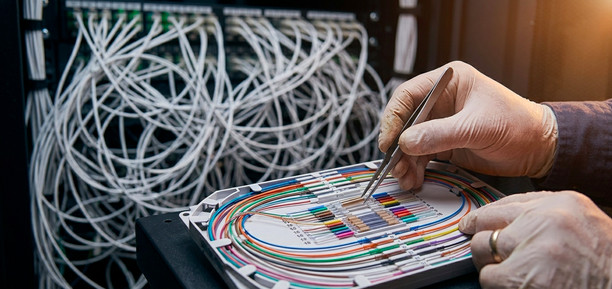
Colour Coded Fibre Optic Pigtails are individual buffer fibres that are stripped on one end for fusion splicing and pre-terminated with a connector on the other. What sets these hardened components apart is the strict adherence to specific color coding protocols for each individual fibre strand. At Fibre Systems, we provide these critical assembly units to ensure that massive optical networks can be terminated quickly, accurately, and without the confusion that leads to costly rework during installation.
The Looming Crisis of the Uncoded Rack
Imagine a network technician standing in front of a High Density Splicing cabinet. Thousands of identical looking white fibre strands pour out of multiple distribution cables. The project deadline is tight, the environment is chaotic, and the technician is tasked with splicing each of these strands into the correct port. When every fibre looks exactly the same, the reliance on manual labelling is absolute. A single misread number or a smudge on a label can trigger a cascade of human error that maps a critical data link to the wrong department.
This is the chaotic reality of an uncoded network. The lack of standard visual cues is not just an inconvenience; it is a major operational risk. It places an immense cognitive load on Field Engineers, slowing down the termination rate and increasing the probability of “fat finger” errors. By utilizing Colour Coded Fibre Optic Pigtails, you replace numerical guesswork with immediate, foolproof visual verification. You effectively move from a “read and match” workflow to a “see and click” workflow, significantly boosting efficiency.
Why International Colour Standards are the Language of Efficiency
The key to unlocking true accuracy in fibre optics lies in standardization. At Fibre Systems, we strictly adhere to International Colour Standards (such as TIA-598). This defines a precise sequence of colors; Blue, Orange, Green, Brown, Slate, White, Red, Black, Yellow, Violet, Rose, Aqua. When you purchase our pigtails, you know that the blue pigtail will always correspond to the first fibre of a 12 strand buffer tube.
This visual shorthand is universally understood by any trained fibre technician on earth. It eliminates language barriers, reduces reliance on potentially confusing technical diagrams, and creates a seamless handoff between different teams. The implementation of a color standard is not about making the rack look clean; it is about providing a structured, logical system that accelerates the entire project lifecycle, from initial deployment to future maintenance.
The Direct Correlation Between Color and Speed
In the fast-paced world of industrial telco and defense networks, installation speed is paramount. A 2,000 port data center requires thousands of individual fusion splices, and choosing Colour Coded Fibre Optic Pigtails allows your team to breeze through these high volume tasks. The time saved per splice by using Colour Coded Fibre Optic Pigtails might only be seconds, but when multiplied by thousands of terminations, the total labor savings are massive.
Color coding removes the “pause and verify” step from the technician’s workflow. A technician can rapidly identify the corresponding fibres in a loose tube cable and a pack of Colour Coded Fibre Optic Pigtails, aligning them for the fusion splicer with zero hesitation. This optimized workflow is crucial for hitting aggressive project deadlines. When you equip your field teams with Colour Coded Fibre Optic Pigtails, you eliminate the need to trace every single unlabelled strand back to its origin. By standardizing your deployment with Colour Coded Fibre Optic Pigtails, you empower your team to achieve a much higher termination rate per shift, ensuring the job is done right and on time.
Technical Advantages: Color Coded vs. Bulk Termination
| Feature | Standard “Natural” Pigtails | Colour Coded Fibre Optic Pigtails |
| Error Rate | High (Relies on labelling) | Extremely Low (Visual confirmation) |
| Splicing Speed | Moderate (Traces required) | Rapid (Plug and Splicing) |
| Skill Requirement | Moderate | Moderate (Field Engineers benefit) |
| Troubleshooting | Slow (Port tracing required) | Fast (Instant color map) |
| Compliance | Non compliant with TIA-598 | Fully compliant (International Colour Standards) |
Redefining the Troubleshooting Process for Field Engineers
A fibre optic technician is only as good as their last fix. When a high density link fails, every minute of downtime counts. A field engineer arrives on site and opens a splicing tray filled with thousands of identical white fibres, but that struggle ends when you switch to Colour Coded Fibre Optic Pigtails. To find the faulty strand, engineers often have to use time consuming charts, but Colour Coded Fibre Optic Pigtails completely change this dynamic by offering instant visual identification.
A technician can immediately look at the color code of the port in question when using Colour Coded Fibre Optic Pigtails. They know that the faults on port 7 are linked to the red pigtail, which connects to the red strand of the internal distribution cable. This “fault to color” mapping provided by Colour Coded Fibre Optic Pigtails is instantaneous. The troubleshooting becomes a targeted operation instead of a search and rescue mission, allowing Field Engineers to restore critical services faster and with higher confidence. By relying on Colour Coded Fibre Optic Pigtails, you transform high stress repair scenarios into simple, efficient tasks.
A Step by Step Guide to a Flawless High Density Splicing Workflow
- Preparation: Unpack the standardized color coded pigtail bundles in sequence (1-12).
- Organization: Manage the pigtails neatly within the splice tray, ensuring correct routing.
- Core Matching: Strip the buffer tubes of the distribution cable, identifying the color coded strands.
- Splicing Execution: Splice the Blue distribution strand to the Blue Fibre Systems pigtail, then Orange to Orange, following the standard.
- Verification: Perform a visual inspection of the tray to confirm all color pairs are correctly spliced.
- Testing: Perform insertion loss testing on the completed links to confirm technical integrity.
The Economics of Standardization: Rework is expensive
The most significant cost in any fibre optics project is labor, and the most expensive part of that labor is rework. If a technician incorrectly splices just 1% of the fibres in a high density cabinet due to labelling errors, the cost of going back, re-troubleshooting, re-cleaving, and re-splicing is devastating to the budget.
Colour Coded Fibre Optic Pigtails are an investment in preventing these “stealth costs.” While the unit price of a color standard product may be marginally higher than bulk unlabelled alternatives, the protection it provides against rework guarantees a lower total cost of ownership. By eliminating the ambiguity from the splicing process, you guarantee that your project is built right the first time, ensuring the long term Network Integrity of your infrastructure.
Frequently Asked Questions
Are color standards consistent between different manufacturers?
If the manufacturer follows TIA-598 International Colour Standards, yes. However, not all manufacturers do. At Fibre Systems, we guarantee that our color coding strictly adheres to the recognized standard for 12 strand sequences.
Do these pigtails come in high fiber count bundles?
We typically provide them in 12 pigtail sets, which are the fundamental unit for color coding standard sequence. For high count splicing, you use multiple standard sets, which maintains the logic of the color mapping.
Are these suitable for fusion splicing with ribbon fibre cables?
Yes, color standard pigtails are commonly used to fan out a ribbon fibre cable for termination into patch panel ports, allowing the organized structure of the ribbon to be carried all the way to the individual connectors.
The Hardened Hardware of Strategic Organization
Organization is not a luxury in high capacity telecommunications; it is the difference between a resilient network and a continuous maintenance headache. Fibre Systems has seen the data and we know that organized networks fail less, restore faster, and cost significantly less to operate over their lifespan. Colour Coded Fibre Optic Pigtails are the foundational component of this strategic organization. They prove that smart hardware design can eliminate the oldest problem in networking: human error.
Stop managing your racks with labels and guesswork and upgrade your infrastructure with strategic color coding. Contact Fibre Systems today to secure your custom quote and experience the reliability of factory certified organization.
Request a custom quote for your next industrial project by contacting the Fibre Systems team today.
View the full range of Fibre Systems tactical solutions designed for the Australian Defence sector.
For more information on Australian cabling standards and safety regulations, visit the ACMA technical cabling rules.
Summary of Advantages:
- Zero Rework Strategy: Eliminates human error during High Density Splicing via immediate visual verification.
- Rapid Deployment: Adherence to International Colour Standards speeds up termination rates by removing traces.
- Streamlined Troubleshooting: Instant fault to port visual mapping for fast service restoration by Field Engineers.
- Universal Language: Splicing workflow is understood globally by any trained technician.