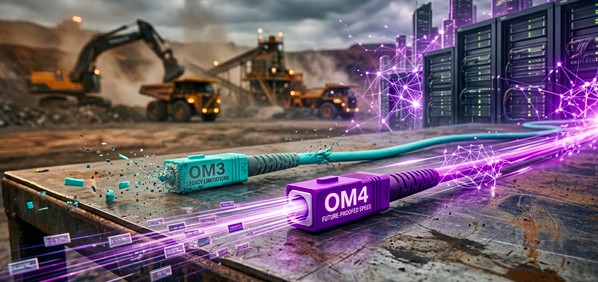
The choice between Single-mode vs Multimode Fibre depends entirely on the distance and bandwidth requirements of your network infrastructure. Single-mode (OS2) is designed for long-range transmission using a single light path, whereas Multimode (OM3/OM4) uses multiple paths for shorter distances. For modern industrial fibre cabling Australia, OM4 has largely superseded OM3 due to its higher bandwidth capacity over longer distances, making it the standard for future-proofed internal networks in demanding sectors.
Navigating Fibre Optic Cable Types
In the world of high-speed data, selecting the right cable medium is just as important as the hardware itself. At Fibre Systems, we specialize in providing ruggedized solutions that ensure signal integrity across diverse environments, from compact data rooms to sprawling mining sites. These fibre optic cable types form the backbone of modern communication, and choosing incorrectly can lead to significant signal loss or expensive hardware mismatches that stall production.
Understanding the fundamental shift between Single-mode vs Multimode Fibre is the first step in designing a resilient network. While both technologies transmit data via light through glass strands, the physical core size determines how that light behaves. Single-mode has a tiny 9-micron core, while Multimode typically uses a 50-micron core, allowing multiple modes of light to bounce along the interior of the cable.
Single-mode vs Multimode: Technical Core Differences
The larger core of Multimode cables allows for the use of lower-cost light sources like Vertical-Cavity Surface-Emitting Lasers (VCSELs). Conversely, the narrow core of OS2 single-mode requires precision-aligned lasers that can push data over massive distances without the signal spreading out, a phenomenon known as modal dispersion.
| Feature | OS2 Single-mode | OM3 vs OM4 Fibre (OM3) | OM3 vs OM4 Fibre (OM4) |
| Jacket Color | Yellow | Aqua | Violet / Erika Violet |
| Distance | Up to 10km+ | Up to 300m (10G) | Up to 400m (10G) |
| Light Source | Precision Laser | VCSEL (Laser) | VCSEL (Laser) |
| Best Use Case | Long Haul / Backbone | Internal Data Centers | High-Speed Industrial |
Multimode Showdown: OM3 vs OM4 Fibre
For many Australian businesses, the technical debate often settles on OM3 vs OM4 fibre. While both are “Laser Optimized” Multimode fibers with 50-micron cores, the difference lies in their “Effective Modal Bandwidth” (EMB). This determines the distance a signal can travel at a specific speed before it becomes unreadable.
OM3 Fibre: The Reliable Standard
OM3 was the workhorse for 10Gbps networks for years. It is perfectly suitable for short-range links within a single server room or small office environment. However, as networks migrate to 40G and 100G, OM3 reaches its distance limits much faster than its successor. If your facility is planning for significant growth or high-definition surveillance integration, OM3 might lead to technical bottlenecks sooner than expected.
OM4 Fibre: Future-Proofing Your Infrastructure
At Fibre Systems, we frequently recommend OM4 fibre for new installations in the Mining and Defence sectors. OM4 provides a significant performance boost, allowing for 100Gbps transmission up to 150 meters. For facilities that require high-speed data across large indoor complexes or underground tunnels, OM4 offers the necessary headroom for future upgrades without the need to re-run cables. It is the most cost-effective way to ensure your internal cabling won’t need replacing as data demands inevitably increase.
When to Choose OS2 Single-mode?
When distance is the primary challenge, OS2 single-mode is the only answer. Because it allows only one mode of light to propagate, it eliminates modal dispersion entirely. This makes it the “Gold Standard” for high-performance Australian infrastructure where reliability over kilometres is a requirement.
- Mining Operations: Connecting remote pits to central command centers located several kilometers away.
- Defence Perimeters: Ensuring secure, long-distance surveillance and communication links across vast tactical ranges.
- Backbone Cabling: Linking multiple buildings across a large industrial campus where distances exceed 500 meters.
While the transceivers for Single-mode are generally more expensive than Multimode versions, the cable itself is often cheaper and offers virtually unlimited bandwidth potential, making it a wise investment for long-term site stability.
Best Practices for Industrial Cable Integration
As part of our commitment to industrial fibre cabling Australia, we suggest technicians follow these essential rules for maintaining high signal quality:
- Match the Transceiver: Never plug a Single-mode cable into a Multimode SFP module. The light will not align correctly with the 9-micron core, and you will get zero signal regardless of the cable quality.
- Color Coding Matters: Use Yellow for OS2 single-mode, Aqua for OM3, and Violet for OM4. This prevents patching errors in high-density racks where visibility might be low and mistakes can lead to site-wide outages.
- Bend Radius Awareness: Industrial environments often involve tight corners and rugged conduits. Ensure you are using “Bend-Insensitive” fibre from Fibre Systems to prevent micro-bends that lead to signal loss and intermittent connectivity issues.
Frequently Asked Questions
Can I join an OM3 cable to an OM4 cable?
Yes, you can physically connect them because they both have a 50-micron core. However, the entire link will perform at the lower OM3 standard. For the best results in high-speed applications, always try to match your cable grades throughout the entire run.
Why is Single-mode used for outdoor and underground runs?
Single-mode has much lower attenuation, meaning the signal stays strong over long distances without needing repeaters. It is less susceptible to external interference and provides the reach needed for sprawling industrial sites and remote outposts.
How do I identify a damaged fibre core in a rugged environment?
We recommend using a Visual Fault Locator (VFL). This tool sends a visible red laser through the fibre; if the core is broken or severely bent, you will see the red light leaking through the jacket at the point of the failure.
Is OM4 compatible with older Multimode hardware?
Generally, yes. OM4 is backward compatible with OM3 and even older OM2 hardware, provided the transceivers are matched to the Multi mode standard. This makes it an ideal choice for phased network upgrades.
Does Fibre Systems provide custom cable lengths for tactical use?
Yes, we specialize in custom-terminated assemblies on tactical reels. We provide pre-terminated ruggedized cables tailored to the specific distance and environmental needs of Australian Defence and Industrial projects.
Selecting the Right Medium with Fibre Systems
The decision between Single-mode vs Multimode Fibre or OM3 vs OM4 fibre isn’t just about the initial price tag; it is about the longevity and scalability of your network. At Fibre Systems, we provide the expertise and the hardware to ensure your cabling infrastructure is as rugged as the environment it serves.
By partnering with a specialist who understands the unique demands of the Australian industrial sector, you can ensure your data stays fast, reliable, and secure for years to come. Whether you are building a new server room or connecting a remote mine site, our team is here to guide you through the complexities of fibre optic cable types.
Request a custom quote for your next industrial project by contacting the Fibre Systems team today.
Fibre Systems Cable Guide: Quick Summary
- Single-mode (OS2): Essential for distances over 500m; identified by Yellow jackets.
- OM3 Multimode: Standard for 10G up to 300m; identified by Aqua jackets.
- OM4 Multimode: High-performance 40G/100G up to 150m; identified by Violet jackets.
- Industrial Choice: Standardize on OS2 single-mode for backbones and OM4 for high-speed internal links.
- Expert Support: Fibre Systems provides ruggedized solutions tailored for Australian Mining and Defence sectors.