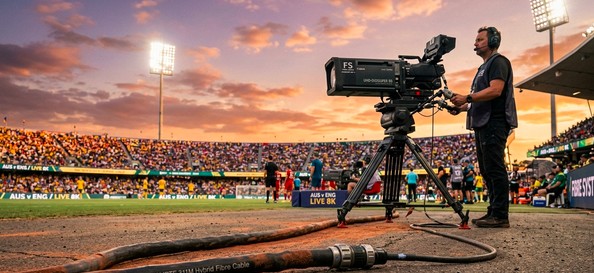
In today’s broadcast and media industry, speed, reliability and flexibility are critical. From live sports and global news coverage to large-scale events and remote film production, seamless data transmission is essential. Rugged broadcast cabling underpins this infrastructure, ensuring consistent performance even in demanding environments.
As demand grows for ultra-high-definition content, real-time streaming and remote production, traditional cabling systems are increasingly limited. Advanced solutions such as pre-terminated fibre systems, singlemode broadcast cabling and broadcast fibre assemblies are now essential to maintain performance, efficiency and broadcast quality.
The Evolution of Broadcast Connectivity
Broadcast connectivity has evolved significantly over the past two decades. Legacy copper-based systems, while once effective, are now constrained by bandwidth limitations, signal degradation and susceptibility to interference. Fibre optic technology has become the industry standard, particularly with the rise of 4K, 8K and immersive media formats.
Fibre optics enable high-speed data transmission over long distances with minimal signal loss. This is especially important in live production environments, where latency and signal interruptions can disrupt operations. The adoption of singlemode broadcast cabling has further improved long-distance connectivity, allowing seamless integration between remote production units and central studios.
Understanding Rugged Broadcast Cabling
Rugged broadcast cabling is specifically designed to withstand the physical and environmental demands of modern media production. Compared to standard fibre cables, these solutions offer enhanced durability and resilience.
Built for Harsh Environments
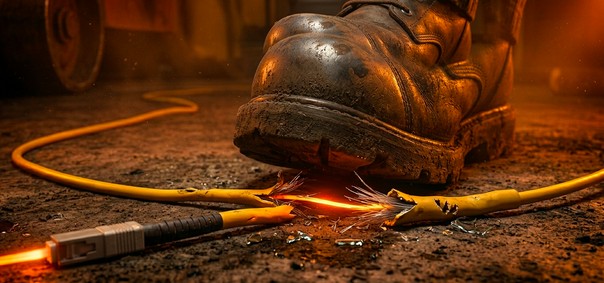
Broadcast environments—particularly outdoor events—often involve exposure to rain, dust, temperature fluctuations and heavy foot traffic. Rugged cabling features reinforced outer jackets, crush resistance and improved flexibility, ensuring consistent performance under these conditions.
Long-Term Reliability
Frequent deployment and pack-down can quickly degrade standard cables. Rugged broadcast cabling is engineered for repeated use without compromising signal integrity, delivering long-term reliability and minimising operational disruption.
The Importance of Pre-Terminated Fibre Solutions
Pre-terminated fibre solutions streamline installation and improve overall system performance by eliminating the need for on-site termination.
Faster Deployment and Reduced Downtime
Time is critical in live broadcasting. Pre-terminated systems enable rapid, plug-and-play deployment, allowing complex networks to be established quickly and efficiently.
Consistent Performance and Reduced Errors
Factory-terminated connectors ensure precise alignment and minimal signal loss. This reduces the risk of installation errors and delivers consistent, high-quality performance across broadcast applications.
Role of Broadcast Fibre Assemblies in Modern Media
Broadcast fibre assemblies simplify complex network configurations by integrating multiple fibre channels into a single solution.
Streamlined Connectivity
In live production environments, video, audio and control signals must be transmitted simultaneously. Fibre assemblies consolidate these connections, reducing cable clutter and simplifying setup.
Enhanced Signal Integrity Over Distance
These assemblies are designed to maintain signal quality across extended distances, making them ideal for large venues and remote production scenarios.
Singlemode Broadcast Cabling for High-Bandwidth Needs
As media production becomes increasingly data-intensive, singlemode broadcast cabling is essential for supporting high-bandwidth applications.
It enables reliable long-distance transmission with minimal loss, making it suitable for live streaming, cloud-based workflows and remote production. Its scalability also ensures compatibility with future technological advancements.
SMPTE Broadcast Connectivity Standards
SMPTE standards have improved the reliability and interoperability of broadcast systems by defining how hybrid fibre solutions are implemented.
Integration of Power and Signal in One Cable
SMPTE hybrid cables combine fibre optics and copper conductors, allowing video, audio and power to be transmitted through a single cable. This reduces complexity and improves efficiency.
Seamless Compatibility Across Equipment
Standardisation ensures compatibility between equipment from different manufacturers, which is essential for large-scale productions involving multiple vendors.
Hybrid Broadcast Fibre Cable in Real-World Applications
A hybrid broadcast fibre cable is a flexible option that takes the best parts of fibre optics and electrical conductors and combines them. It is common in professional camera systems because it connects cameras to base stations and sends power and high-definition signals.
These cables are very useful in places where things are always changing and people need to be able to move around and be flexible. Hybrid solutions make setup easier and more efficient by cutting down on the number of cables needed. This lets production teams focus on making content instead of dealing with technical issues.
Mobility and Flexibility with Tactical Fibre Reels
Mobility is essential in modern broadcasting, particularly for temporary setups and field operations. Effective cable management plays a key role in maintaining efficiency.
Why Teams Invest in Tactical Fibre Reel Solutions
Tactical fibre reels provide a portable, durable solution for managing fibre cables. They support quick deployment and pack-down, improving operational efficiency.
Protecting Cable Integrity During Deployment
These reels prevent tangling, bending and physical damage, helping maintain cable performance and extending service life.
Advantages of Rugged Fibre Solutions in Live Broadcasting
Live broadcasting presents demanding operational conditions where reliability is essential. Technical failures can result in lost content, revenue and audience trust.
Rugged fibre solutions provide high bandwidth, low latency and resistance to environmental factors, ensuring stable and consistent signal transmission across all types of live productions.
Cost Efficiency Through Long-Term Performance
While rugged and pre-terminated solutions may involve higher upfront costs, they offer significant long-term savings.
Their durability reduces replacement frequency, while consistent performance lowers maintenance requirements. Faster deployment also reduces labour costs, resulting in a lower total cost of ownership over time.
Future-Proofing Broadcast Infrastructure
The broadcast industry continues to evolve with technologies such as cloud production, IP-based workflows and immersive media.
Investing in scalable, high-capacity fibre infrastructure ensures networks remain capable of supporting future requirements. Rugged and pre-terminated solutions provide the flexibility and performance needed to adapt to ongoing industry changes.
Conclusion
As broadcast operations become more complex, the need for reliable, efficient and durable connectivity solutions continues to grow. Rugged broadcast cabling and pre-terminated fibre systems are essential for ensuring fast deployment, consistent performance and dependable connectivity in demanding environments.
By integrating broadcast fibre assemblies, singlemode broadcast cabling, SMPTE-compliant solutions and hybrid fibre cable, media organisations can build scalable and resilient networks that support modern production workflows.
To remain competitive, investing in advanced fibre solutions is critical. Tactical fibre reel systems further enhance mobility and operational efficiency. Contact us to explore tailored fibre solutions designed to strengthen and future-proof your broadcast infrastructure.
FAQs
1. Why is rugged broadcast cabling important in media production?
It ensures reliable signal transmission in demanding environments, protecting against physical damage, environmental exposure and repeated handling.
2. What are broadcast fibre assemblies used for?
They consolidate multiple signal types—such as video, audio and data—into a single solution, simplifying connectivity and improving performance.
3. How does singlemode broadcast cabling support long-distance transmission?
It enables high-speed data transfer over long distances with minimal signal loss, making it ideal for remote and high-bandwidth applications.
4. What is SMPTE broadcast connectivity?
It refers to industry standards that enable hybrid cables to transmit video, audio and power through a single, integrated solution.
5. Why invest in tactical fibre reel solutions?
They improve cable management, support rapid deployment, reduce damage and ensure consistent performance in field and temporary broadcast setups.