Modern broadcasting has evolved far beyond traditional studio environments. Today’s broadcast engineers, media production houses, and event network planners manage complex workflows involving live streaming, multi-camera production, ultra-high-definition video feeds, and remote production units. Every element of this workflow depends on dependable connectivity capable of handling massive volumes of data without interruption. This is where broadcast fibre assemblies play a crucial role.
From large stadium productions to international concerts and television studios, fibre optic connectivity has become an essential part of professional broadcasting infrastructure. Compared with traditional copper networks, fibre optics offers significantly higher bandwidth, minimal signal loss, and the ability to transmit data across long distances with exceptional stability. However, broadcast environments often involve demanding conditions such as constant cable handling, outdoor deployments, and rapid installation schedules. Rugged, pre-terminated fibre solutions are specifically designed to meet these challenges while maintaining reliable performance.
Broadcast professionals increasingly rely on rugged broadcast cabling that can withstand the physical demands of live production while delivering consistent signal quality. These solutions simplify deployment, reduce installation time, and ensure stable communication between cameras, production trucks, control rooms, and media servers. As broadcast technology continues to evolve, specialised fibre infrastructure designed for media environments has become essential rather than optional.
The Growing Demand for Fibre Connectivity in Broadcasting
The broadcasting industry now operates in a highly digital and real-time environment where enormous volumes of data must move instantly between production systems. High-definition and ultra-high-definition video formats require large amounts of bandwidth, and traditional cabling infrastructure often struggles to meet these requirements. Fibre optic technology provides the performance capabilities necessary to support modern broadcast workflows.
Broadcast facilities rely heavily on fibre connections to transmit multiple signal types simultaneously. Video, audio, control data, and monitoring information can all travel across a single fibre link without degrading signal quality. This capability allows production teams to connect cameras positioned across stadiums, arenas, or outdoor event spaces while maintaining flawless signal clarity throughout the production process.
Benefits of Pre-Terminated Fibre for Broadcast Engineers
Pre-terminated fibre systems are particularly valuable in broadcast environments because they arrive ready for deployment. Instead of performing complex fibre termination procedures at the venue, engineers can simply connect the cables and immediately begin transmitting data.
This approach significantly reduces installation time during live event setups where schedules are extremely tight. Production teams often have limited time to build an entire communications network before a broadcast begins. Pre-terminated fibre assemblies eliminate time-consuming tasks and allow technicians to focus on configuring the broadcast systems rather than assembling the cabling infrastructure.
Supporting Remote Production Workflows
Another major factor driving fibre adoption is the rise of remote production models. Broadcasters increasingly transmit camera feeds from event venues to centralised production facilities located hundreds or even thousands of kilometres away. These workflows require high-capacity connections capable of transporting large data streams with minimal latency.
Single-mode broadcast cabling is frequently used for these applications because it supports long-distance signal transmission with very low attenuation. As remote production becomes more common, fibre connectivity will continue to serve as the backbone of modern broadcasting networks.
What Are Broadcast Fibre Assemblies?
Broadcast fibre assemblies are specialised fibre optic cable systems specifically engineered for media production environments. These assemblies typically include ruggedised connectors, protective outer jackets, and factory-terminated fibre cores that enable rapid deployment in demanding broadcast situations.
Unlike standard fibre cables used in office networks or data centres, broadcast assemblies are designed for mobility and frequent handling. They are often deployed on cable reels, routed across stadium floors, or temporarily installed during large live events. As a result, durability and flexibility are essential features.
The design of broadcast fibre assemblies ensures that cables remain protected from physical stress while maintaining consistent optical performance. These solutions enable broadcast engineers to build high-performance network links quickly and reliably, even in challenging environments.
SMPTE Fibre Cable in Professional Broadcasting
One of the most widely used fibre solutions in professional broadcasting is the SMPTE fibre cable. This specialised cable type is designed to connect broadcast cameras to camera control units while simultaneously transmitting multiple signals.
SMPTE cables carry high-definition video signals along with camera control data and electrical power within a single cable assembly. This integrated design simplifies production setups by replacing several individual cables with one streamlined connection.
In large venues such as sports arenas or concert halls, SMPTE fibre assemblies allow cameras to be positioned far from the control room while maintaining stable connectivity. This flexibility enables creative camera placement and improves overall production quality.
The rugged construction of SMPTE cables ensures that they can tolerate continuous movement, environmental stress, and frequent reconnections. For broadcast engineers working in fast-paced production environments, this durability is critical.
opticalCON Connectors and High-Performance Fibre Links
Another key component of broadcast fibre infrastructure is the opticalCON connector system. These connectors are specifically designed for demanding field conditions where reliability and durability are essential.
opticalCON connectors provide secure fibre connections using protective housings that shield delicate fibre cores from dust, moisture, and mechanical damage. In outdoor productions or touring environments, this protection is extremely important.
Broadcast engineers often work in unpredictable environments where cables may be stepped on, dragged across floors, or exposed to weather conditions. The robust design of opticalCON connectors ensures that fibre links remain stable even under heavy usage.
The plug-and-play nature of these connectors also accelerates deployment. Technicians can quickly connect or disconnect fibre links without specialised tools, making opticalCON systems ideal for temporary broadcast installations and live event productions.
Rugged Fibre Infrastructure for Stadiums and Live Events
Live event broadcasting presents unique connectivity challenges. Large productions such as international sporting events, music festivals, and entertainment broadcasts require extensive network infrastructure that must be installed rapidly and operate flawlessly.
Rugged fibre systems are specifically designed to meet these demands by providing high reliability and physical durability.
Reliability in High-Traffic Production Environments
Large venues often require kilometres of cabling to connect cameras, lighting systems, audio equipment, broadcast control units, and data servers.
These cables must remain reliable despite:
- Heavy foot traffic
- Equipment movement
- Outdoor conditions
Rugged broadcast cabling uses reinforced outer jackets, strain-relief systems, and durable connectors to protect the internal fibre cores.
For live broadcasts, reliability is absolutely critical. A damaged cable during a major sports event could interrupt video feeds and impact millions of viewers worldwide.
Rugged fibre assemblies significantly reduce this risk by delivering dependable connectivity in demanding conditions.
Fibre Solutions for Mobile Broadcast Setups
Outside broadcast vehicles and mobile production units rely heavily on flexible fibre infrastructure that can be deployed and packed down quickly.
Production crews regularly move between venues, so portable connectivity solutions are essential.
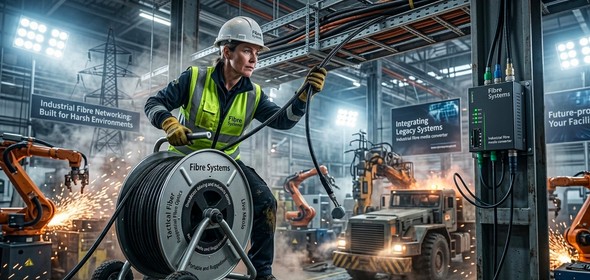
Cable reel systems are widely used because they allow technicians to deploy long fibre runs quickly while keeping cables organised.
Tactical fibre reel systems combine durable cable construction with convenient storage mechanisms, making transportation and setup much easier for touring broadcast teams.
Hybrid Fibre Solutions for Modern Broadcast Workflows
Modern broadcast networks increasingly rely on fibre systems capable of carrying multiple signal types simultaneously. Hybrid fibre cables are designed to meet this need.
Hybrid Power-Plus-Data Fibre Cables
Hybrid broadcast fibre cables integrate fibre optic cores with copper conductors within the same cable structure.
This allows the cable to transmit high-bandwidth video data while also delivering electrical power to connected equipment.
This is particularly useful for:
- Broadcast cameras
- Field monitors
- Remote production gear
Instead of running separate cables for power and data, engineers can use a single hybrid cable to perform both tasks.
Reducing cable numbers simplifies production setups and minimises cable management issues during live events.
Plug-and-Play Fibre for Video Transmission
Plug-and-play fibre assemblies simplify broadcast installations by eliminating complicated fibre termination processes.
Pre-terminated connectors allow technicians to establish network links quickly without specialised tools.
For live productions operating under tight schedules, this speed is incredibly valuable.
Factory-terminated connectors also deliver consistent optical performance, as they are installed in controlled environments rather than in the field.
The Importance of Single-Mode Fibre in Broadcasting
As broadcast networks expand across large venues and remote production environments, transmission distance becomes increasingly important.
Single-mode fibre is widely used in broadcasting because it supports long-distance communication while maintaining excellent signal quality.
Long-Distance Signal Transmission
Single-mode fibre features a very small core that allows light signals to travel in a straight path with minimal dispersion.
This enables signals to travel significantly further than with multimode fibre.
In large stadiums or multi-venue productions, single-mode fibre allows broadcast teams to transmit video signals over hundreds or even thousands of metres without signal degradation.
Future-Ready Broadcast Infrastructure
Broadcast technology continues to evolve rapidly. Higher video resolutions, advanced graphics systems, and immersive production formats require ever-increasing data capacity.
Single-mode fibre is considered a future-ready infrastructure because it can support extremely high data rates and long transmission distances.
Investing in high-quality broadcast fibre assemblies built with single-mode fibre helps broadcasters stay prepared for future technological advancements.
Although fibre optic cables are highly reliable, proper maintenance is essential to ensure consistent performance.
Technicians should always protect fibre connectors from dust and contamination by using protective caps when cables are not in use.
Maintaining Fibre Systems in Broadcast Environments
Cleaning fibre connectors before deployment also helps maintain optimal signal quality.
Proper cable management is equally important. Using cable reels, avoiding tight bends, and storing cables in protective cases can significantly extend the lifespan of fibre assemblies.
By combining rugged cable construction with good maintenance practices, broadcast teams can maintain dependable fibre networks for years.
Conclusion
Broadcast and media companies rely on connectivity systems that deliver speed, reliability, and durability in demanding environments.
Whether operating in television studios, sports stadiums, outdoor events, or mobile production units, fibre optic technology is essential for modern broadcasting.
Specialised broadcast fibre assemblies support high-bandwidth video transmission while offering the rugged construction required for real-world production environments.
Solutions such as SMPTE camera connections, opticalCON connectors, and cable reel systems allow for fast deployment and stable signal transmission during live broadcasts. Hybrid fibre cables simplify workflows by combining power and data into a single connection, while single-mode cabling enables long-distance communication across large venues and remote production facilities.
To learn more about reliable broadcast fibre solutions for your network, contact us today. Investing in high-quality fibre infrastructure helps broadcasters build dependable systems that are ready for the future of media production.
FAQs
1. What are broadcast fibre assemblies?
Broadcast fibre assemblies are rugged fibre optic cable systems designed for media production. They provide reliable, high-bandwidth connectivity for cameras, control rooms, and broadcast equipment during live productions.
2. Why are pre-terminated fibre cables useful for broadcasting?
Pre-terminated fibre cables arrive ready to connect, reducing installation time and the risk of errors. They allow broadcast engineers to deploy networks quickly during live events and temporary production setups.
3. What is SMPTE fibre cable used for?
SMPTE fibre cable connects professional broadcast cameras to control units. It carries video signals, camera control data, and electrical power through a single cable for efficient production workflows.
4. Why are opticalCON connectors used in broadcast systems?
opticalCON connectors provide strong and secure fibre connections in demanding environments. They protect fibre cores from dust, moisture, and physical damage during outdoor broadcasts and touring productions.
5. Why is single-mode fibre important in broadcasting?
Single-mode fibre supports long-distance signal transmission with minimal loss. It is ideal for stadiums, large venues, and remote production workflows that require reliable, high-quality broadcast connectivity.